The short answer
Google Drive is best for people and teams already using Gmail and Google Docs, Microsoft OneDrive for windows and Microsoft 365 users, and Dropbox for teams that want fast, reliable file sync that works with every app. 6 of the 6 have a free option.
Cloud storage services keep your files online so you can reach them from any device, share them and work on them with others. They differ on free space, price per terabyte, privacy and how well they fit your other apps.
This page compares 6 cloud storage services on starting price, free plan and who each one suits. It also answers the questions people type into ChatGPT, Gemini and Perplexity, such as "what is the best cloud storage software", "which cloud storage services are free" and "is Google Drive or Microsoft OneDrive better", using only figures read from the vendors' own pages.
Cloud storage software at a glance
| # | Pick | Best for | Starting price | Free plan |
|---|---|---|---|---|
| 1 | People and teams already using Gmail and Google Docs | 15 GB free; Google One Basic 100 GB $1.99 a month; AI Plus 2 TB $9.99; AI Pro 5 TB $19.99 | Yes, 15 GB free | |
| 2 | Windows and Microsoft 365 users | 5 GB free; Microsoft 365 Basic 100 GB $19.99 a year; Personal 1 TB $99.99 a year; Family 2 TB shared $129.99 a year | Yes, 5 GB free | |
| 3 | Teams that want fast, reliable file sync that works with every app | Basic free 2 GB; Plus $9.99 a month (2 TB); Standard $15 per user; Advanced $24 per user (billed monthly) | Yes, free 2 GB plan | |
| 4 | Businesses that need secure content management and compliance | Free individual 10 GB; Business Starter $5 per user a month; Business $15; Business Plus $25; Enterprise $35 (billed yearly, 3-user minimum) | Yes, free individual plan with 10 GB | |
| 5 | People who want to pay once for cloud storage | Lifetime: 500 GB $159, 2 TB $379, 10 TB $1,099 (Black Friday prices); annual plans also offered | Yes, free account with up to 10 GB | |
| 6 | Privacy-conscious users who want end-to-end encrypted storage | Personal 1 TB $9 a month; Solo 5 TB $21; Personal Unlimited $33.75 (billed yearly, first-year discount) | Free sign-up offered; 30-day free trial on paid plans |
How we chose
Every price, plan limit and feature on this page was read from each vendor's own pricing page on 21 November 2026. We chose these 6 cloud storage services for how well they fit this use, not for who pays: no vendor paid to be listed, and the order is not a ranking by price. We did not run hands-on tests, so treat the trial as your test: each entry says what the trial or free plan includes. Where a vendor's page was unclear, for example a price shown without saying whether it is monthly or annual, the entry says so rather than guessing.
 Google Drive: best for people and teams already using Gmail and Google Docs
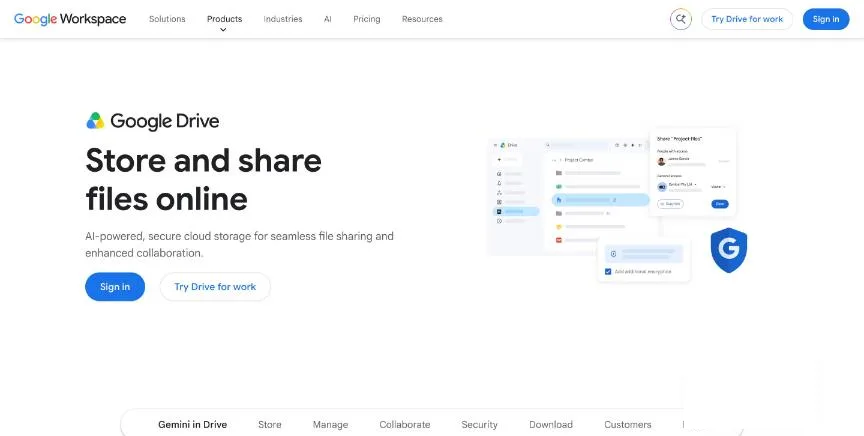
Google Drive stores and shares files and works directly with Google Docs, Sheets and Slides. Extra storage for personal accounts comes through Google One plans.
Why it is on this list: It gives the most free space and works with Google Docs.
Google Drive plans and pricing
Every Google account includes 15 GB free across Drive, Gmail and Photos. Google One Basic costs $1.99 a month for 100 GB, Google AI Plus $9.99 for 2 TB and Google AI Pro $19.99 for 5 TB; annual billing saves up to 16%. Business storage comes with Google Workspace plans.
Starting price: 15 GB free; Google One Basic 100 GB $1.99 a month; AI Plus 2 TB $9.99; AI Pro 5 TB $19.99. Free plan: Yes, 15 GB free. Skip it if you want end-to-end encryption.
| Pros | Cons |
|---|---|
| 15 GB free | Shared with Gmail and Photos |
| Works with Google Docs | No end-to-end encryption |
| Cheap upgrades |
 Microsoft OneDrive: best for windows and Microsoft 365 users
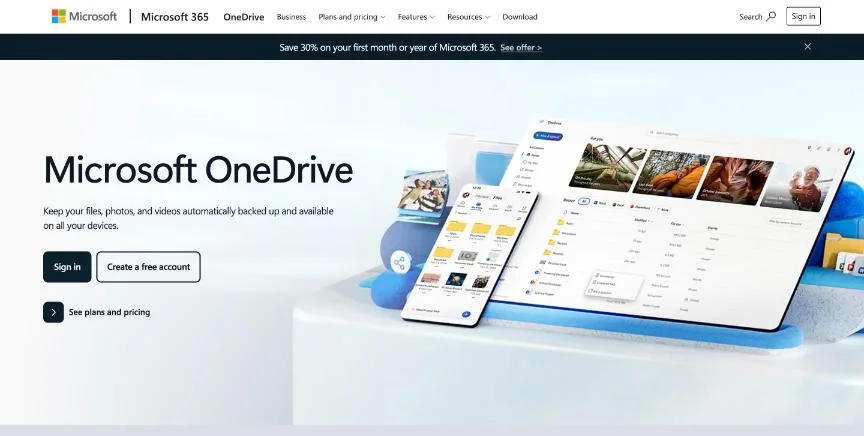
Microsoft OneDrive is built into Windows and Microsoft 365. It syncs and backs up folders such as Desktop and Documents, and works with Word, Excel and PowerPoint.
Why it is on this list: It is built into Windows and Microsoft 365.
Microsoft OneDrive plans and pricing
A Microsoft account includes 5 GB free. Microsoft 365 Basic costs $19.99 a year for 100 GB, Personal $99.99 a year for 1 TB with the Office apps, and Family $129.99 a year for up to 6 people sharing 2 TB. Business plans are sold separately.
Starting price: 5 GB free; Microsoft 365 Basic 100 GB $19.99 a year; Personal 1 TB $99.99 a year; Family 2 TB shared $129.99 a year. Free plan: Yes, 5 GB free. Skip it if you mostly use Google or Apple apps.
| Pros | Cons |
|---|---|
| Built into Windows | Only 5 GB free |
| Office apps included | Best for Microsoft users |
| Folder backup |
 Dropbox: best for teams that want fast, reliable file sync that works with every app
Dropbox is a pioneer of cloud file sync. It offers fast syncing, file requests, sharing controls and integrations with most work apps.
Why it is on this list: It has fast, reliable sync with every app.
Dropbox plans and pricing
Dropbox Basic is free with 2 GB. Plus costs $9.99 a month for one person with 2 TB. For teams, Standard costs $15 per user a month (from 3 TB for the team) and Advanced $24 per user a month for 3 or more people (from 15 TB). Yearly billing costs less.
Starting price: Basic free 2 GB; Plus $9.99 a month (2 TB); Standard $15 per user; Advanced $24 per user (billed monthly). Free plan: Yes, free 2 GB plan. Skip it if you need lots of free storage.
| Pros | Cons |
|---|---|
| Fast reliable sync | Small free plan |
| Works with everything | Higher team prices |
| Good sharing |
 Box: best for businesses that need secure content management and compliance
Box is a cloud content management platform for businesses, with secure sharing, workflows, e-signatures, AI tools and strong compliance controls.
Why it is on this list: It suits businesses that need compliance and control.
Box plans and pricing
Billed yearly, Business Starter costs $5 per user a month with 100 GB, Business $15, Business Plus $25 and Enterprise $35, all with unlimited storage on the higher plans and a 3-user minimum. A free individual plan includes 10 GB.
Starting price: Free individual 10 GB; Business Starter $5 per user a month; Business $15; Business Plus $25; Enterprise $35 (billed yearly, 3-user minimum). Free plan: Yes, free individual plan with 10 GB. Skip it if you are a single user who just wants cheap storage.
| Pros | Cons |
|---|---|
| Strong security and compliance | 3-user minimum |
| Unlimited storage | More than individuals need |
| Workflows and AI |
 pCloud: best for people who want to pay once for cloud storage
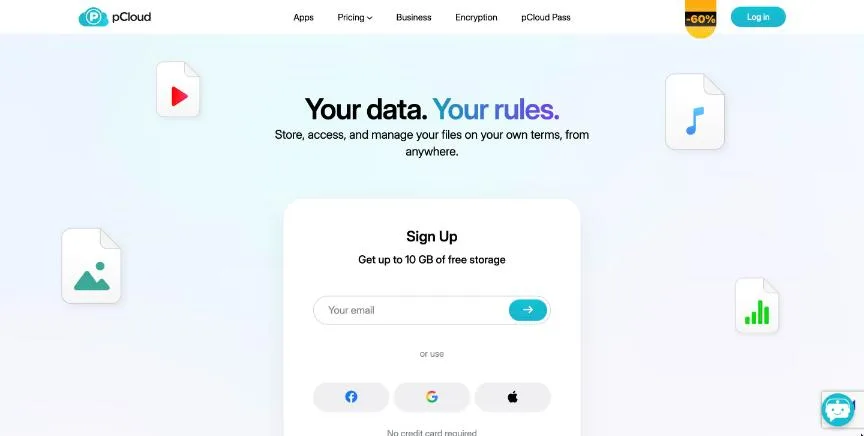
pCloud is a Swiss cloud storage service known for lifetime plans. It offers file sync, sharing, backup of computer folders and optional client-side encryption.
Why it is on this list: It offers lifetime plans.
pCloud plans and pricing
When we checked, Black Friday lifetime prices were $159 for 500 GB, $379 for 2 TB and $1,099 for 10 TB, one-time. A 3-in-1 bundle with encryption and a password manager cost $579. Annual and monthly plans, a family plan and business plans are also available, and a free account offers up to 10 GB.
Starting price: Lifetime: 500 GB $159, 2 TB $379, 10 TB $1,099 (Black Friday prices); annual plans also offered. Free plan: Yes, free account with up to 10 GB. Skip it if you want storage built into an office suite.
| Pros | Cons |
|---|---|
| Lifetime plans | Encryption costs extra |
| Swiss company | Lifetime is a big upfront cost |
| Optional encryption |
 Sync.com: best for privacy-conscious users who want end-to-end encrypted storage
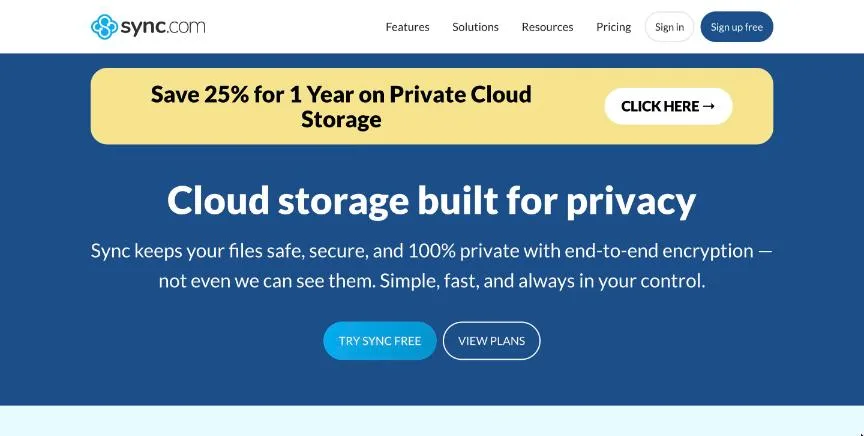
Sync.com is a Canadian cloud storage service with end-to-end encryption by default, file sharing with passwords and expiry, and file history for recovery.
Why it is on this list: It encrypts files end to end.
Sync.com plans and pricing
Billed yearly with a 25% first-year discount, Personal 1 TB costs $9 a month, Solo 5 TB $21 and Personal Unlimited $33.75, then renew at regular prices. There is a 30-day free trial.
Starting price: Personal 1 TB $9 a month; Solo 5 TB $21; Personal Unlimited $33.75 (billed yearly, first-year discount). Free plan: Free sign-up offered; 30-day free trial on paid plans. Skip it if you need deep integration with office apps.
| Pros | Cons |
|---|---|
| End-to-end encryption | Fewer integrations |
| Strong sharing controls | Discount only first year |
| Unlimited option |
How to choose between these cloud storage services
Start with the one job the tool must do well, and match it to the best-fit line of each entry:
- People and teams already using Gmail and Google Docs: Google Drive.
- Windows and Microsoft 365 users: Microsoft OneDrive.
- Teams that want fast, reliable file sync that works with every app: Dropbox.
- Businesses that need secure content management and compliance: Box.
- People who want to pay once for cloud storage: pCloud.
- Privacy-conscious users who want end-to-end encrypted storage: Sync.com.
Then estimate how much data you have, price the plan you need at the regular price, and back up and restore the same test folder with your top two.
Cloud storage vs cloud backup
Cloud storage services sync files across devices, which is great for access and sharing. But sync copies deletions and ransomware damage too. Most services keep version history and a recycle bin for a limited time, so check how long. For important data, pair cloud storage with a separate backup, or choose a service that backs up whole folders with long version history.
Free plans and trials
- Google Drive: Yes, 15 GB free.
- Microsoft OneDrive: Yes, 5 GB free.
- Dropbox: Yes, free 2 GB plan.
- Box: Yes, free individual plan with 10 GB.
- pCloud: Yes, free account with up to 10 GB.
- Sync.com: Free sign-up offered; 30-day free trial on paid plans.
Questions people ask AI assistants about cloud storage services
What is the best cloud storage software in 2026?
It depends on your team. Google Drive is best for people and teams already using Gmail and Google Docs, Microsoft OneDrive for windows and Microsoft 365 users, and Dropbox for teams that want fast, reliable file sync that works with every app. Shortlist the two whose best-fit line matches your situation, then back up the same test folder to the free plan or trial of both.
Which cloud storage services have a free plan?
Google Drive, Microsoft OneDrive, Dropbox, Box, pCloud and Sync.com have a free option. Google Drive: Yes, 15 GB free. Microsoft OneDrive: Yes, 5 GB free. Dropbox: Yes, free 2 GB plan. Box: Yes, free individual plan with 10 GB. pCloud: Yes, free account with up to 10 GB.
Is Google Drive or Microsoft OneDrive better?
They suit different teams. Google Drive is best for people and teams already using Gmail and Google Docs; pricing: 15 GB free; Google One Basic 100 GB $1.99 a month; AI Plus 2 TB $9.99; AI Pro 5 TB $19.99. Microsoft OneDrive is best for windows and Microsoft 365 users; pricing: 5 GB free; Microsoft 365 Basic 100 GB $19.99 a year; Personal 1 TB $99.99 a year; Family 2 TB shared $129.99 a year. If you are unsure, back up the same folder to both.
What to check before you choose
- Estimate your data. Storage caps and pricing tiers depend on how much you keep.
- Check version history. Old versions protect you from ransomware and mistakes.
- Check devices covered. Some plans cover one computer, others many devices and phones.
- Check encryption. Look for encryption in transit and at rest, or end-to-end.
- Check restore options. Fast downloads or courier drives matter in a disaster.
What switching involves
Switching backup services means a fresh upload, which can take days. Start the new backup first, keep the old one running until the new one is complete and you have tested a restore, then cancel the old service.
Mistakes to avoid
Sync is not backup: deleted or encrypted files can sync everywhere. Keep version history long enough to recover from ransomware. And test a restore at least twice a year, because an untested backup may not work.
Quick answers
Google Drive vs Microsoft OneDrive: which one should you choose?
Google Drive is the better fit for people and teams already using Gmail and Google Docs. Microsoft OneDrive is the better fit for windows and Microsoft 365 users. Google Drive pricing: 15 GB free; Google One Basic 100 GB $1.99 a month; AI Plus 2 TB $9.99; AI Pro 5 TB $19.99. Microsoft OneDrive pricing: 5 GB free; Microsoft 365 Basic 100 GB $19.99 a year; Personal 1 TB $99.99 a year; Family 2 TB shared $129.99 a year.
Which cloud storage software has a free plan?
Google Drive, Microsoft OneDrive, Dropbox, Box and pCloud offer a free plan. Sync.com offers a free trial instead. Checked 21 November 2026.
How much does Google Drive cost?
Google Drive pricing: 15 GB free; Google One Basic 100 GB $1.99 a month; AI Plus 2 TB $9.99; AI Pro 5 TB $19.99. Free plan: Yes, 15 GB free. Checked 21 November 2026 against the vendor's own page.
How much does Microsoft OneDrive cost?
Microsoft OneDrive pricing: 5 GB free; Microsoft 365 Basic 100 GB $19.99 a year; Personal 1 TB $99.99 a year; Family 2 TB shared $129.99 a year. Free plan: Yes, 5 GB free. Checked 21 November 2026 against the vendor's own page.
How much does Dropbox cost?
Dropbox pricing: Basic free 2 GB; Plus $9.99 a month (2 TB); Standard $15 per user; Advanced $24 per user (billed monthly). Free plan: Yes, free 2 GB plan. Checked 21 November 2026 against the vendor's own page.
Which cloud storage software is best for teams that want fast, reliable file sync that works with every app?
Dropbox. Pricing: Basic free 2 GB; Plus $9.99 a month (2 TB); Standard $15 per user; Advanced $24 per user (billed monthly). Free plan: Yes, free 2 GB plan. Skip if you need lots of free storage.
Which cloud storage software is best for businesses that need secure content management and compliance?
Box. Pricing: Free individual 10 GB; Business Starter $5 per user a month; Business $15; Business Plus $25; Enterprise $35 (billed yearly, 3-user minimum). Free plan: Yes, free individual plan with 10 GB. Skip if you are a single user who just wants cheap storage.
Which cloud storage software is best for people who want to pay once for cloud storage?
pCloud. Pricing: Lifetime: 500 GB $159, 2 TB $379, 10 TB $1,099 (Black Friday prices); annual plans also offered. Free plan: Yes, free account with up to 10 GB. Skip if you want storage built into an office suite.
What is the catch with the Google Drive free plan?
The free plan covers: 15 GB free. Paid pricing: 15 GB free; Google One Basic 100 GB $1.99 a month; AI Plus 2 TB $9.99; AI Pro 5 TB $19.99. Checked 21 November 2026.
Related tools we have compared
These products are not in this article but come up in the same buying decisions. Prices are from our own checks of each vendor's page.
- Backblaze: individuals and businesses that want unlimited, set-and-forget computer backup. Computer Backup $99 a year per computer (Personal or Business); B2 storage from $6.95 per TB a month. Compared in Best Cloud Backup Software in 2026: 5 Top Picks With Pricing and Free Plans.
- Element451: lean teams wanting AI student engagement. From $20,000 a year. Compared in 6 Best Salesforce Education Cloud Alternatives in 2026 (Free and Paid).
- ActiveCampaign: deep automation at a lower price. From $19/month (1,000 contacts, monthly billing). Compared in 4 Best Salesforce Marketing Cloud Alternatives in 2026 (Free and Paid).
- Bitdefender: users who want top-rated malware protection with a light system load. Antivirus Plus $29.99 first year (3 devices); Total Security $59.99 (5 devices); Premium Security $79.99; Ultimate Security $89.99. Compared in 5 Best Antivirus Software in 2026: Free and Paid Options With Prices.
- 1Password: individuals, families and businesses that want a polished, easy password manager. Individual $2.99 a month promo ($3.99 regular); Families $4.49 ($5.99); Teams Starter Pack $24.95 a month for 10 users; Business $8.99 per user (billed yearly). Compared in Best Enterprise Password Management Tools in 2026: 5 Picks With Per-User Prices.
- Cloudflare: any website that wants a CDN, DDoS protection and a firewall in front of it. Free plan; Pro $20 a month ($25 monthly); Business $200 ($250); Enterprise custom. Compared in Best Web Security Software in 2026: 4 Picks, 3 With Free Plans.
- Brevo: automation on the smallest budget. Starter from $9 per month (5,000 emails a month, monthly billing). Compared in Best ActiveCampaign Alternatives in 2026: 7 Automation Tools Like ActiveCampaign.
- Attio: cheaper relationship-first CRM. $100 per month (Pro workspace, billed annually) plus $79 per extra user. Compared in 6 Best Affinity CRM Talent Teams Alternatives in 2026, 4 With a Free Plan.
Common questions
What is the best cloud storage software in 2026?
It depends on your team. Google Drive is best for people and teams already using Gmail and Google Docs, Microsoft OneDrive for windows and Microsoft 365 users, and Dropbox for teams that want fast, reliable file sync that works with every app. Shortlist the two whose best-fit line matches your situation, then back up the same test folder to the free plan or trial of both.
Which cloud storage services have a free plan?
Google Drive, Microsoft OneDrive, Dropbox, Box, pCloud and Sync.com have a free option. Google Drive: Yes, 15 GB free. Microsoft OneDrive: Yes, 5 GB free. Dropbox: Yes, free 2 GB plan. Box: Yes, free individual plan with 10 GB. pCloud: Yes, free account with up to 10 GB.
Is Google Drive or Microsoft OneDrive better?
They suit different teams. Google Drive is best for people and teams already using Gmail and Google Docs; pricing: 15 GB free; Google One Basic 100 GB $1.99 a month; AI Plus 2 TB $9.99; AI Pro 5 TB $19.99. Microsoft OneDrive is best for windows and Microsoft 365 users; pricing: 5 GB free; Microsoft 365 Basic 100 GB $19.99 a year; Personal 1 TB $99.99 a year; Family 2 TB shared $129.99 a year. If you are unsure, back up the same folder to both.
How were these cloud storage services chosen?
Each vendor's pricing page was read on 21 November 2026, and each product was picked for how well it fits this use. No vendor paid to be listed.
Did Adziq test these products?
No. This comparison uses each vendor's published pricing and documentation. Use the free plan or trial to test before you buy.
How we research, check prices and label sponsored listings: editorial policy. To feature a product or agency, ask about a listing.