The short answer
Element451 suits lean teams wanting AI student engagement, Ellucian CRM Advance suits advancement and alumni fundraising teams, and Freshsales suits small teams wanting a simple pipeline. Salesforce Education Cloud pricing: From $87 a user a month billed annually (nonprofit pricing). Element451 pricing: From $20,000 a year. Ellucian CRM Advance pricing: Pricing on request. 2 of the 6 alternatives have a free plan.
Why look for a Salesforce Education Cloud alternative
Cloud is the education edition of the Salesforce platform, covering recruitment and admissions, student success, academic operations and advancement in one system. The entry edition, Education Cloud Sales and Service Core, costs $87 a user a month billed annually on nonprofit pricing. Advanced costs $131 a user a month, and the Max editions cost $350 to $363 a user a month. Those figures are nonprofit rates; for-profit institutions are directed to a pricing guide and an account executive. Fifty users on Core cost $52,200 a year before implementation, add-ons such as Data Cloud or Agentforce, and the administration time the platform demands.
People usually switch for one of three reasons: the price at their size, a limit on the plan they are on, or a feature that sits on a higher tier. Salesforce Education Cloud's own figures, for reference: starting price From $87 a user a month billed annually (nonprofit pricing); free plan: No, free trial available.
Salesforce Education Cloud Alternatives at a glance
| # | Pick | Best for | Starting price | Free plan |
|---|---|---|---|---|
| 1 | Lean teams wanting AI student engagement | From $20,000 a year | No | |
| 2 | Advancement and alumni fundraising teams | Pricing on request | No | |
| 3 | Small teams wanting a simple pipeline | From $9 a user a month billed annually (Growth) | No, 21-day free trial | |
| 4 | Small admissions and marketing teams | From $20 a seat a month (Sales Hub Starter, list rate) | Yes, free CRM | |
| 5 | Admissions-led colleges and universities | From $30,000 a year (institutional licence) | No | |
| 6 | Small programmes on a tight budget | From $14 a user a month billed annually (Standard) | Yes, free for up to 3 users |
How we chose
These are the products that Adziq compares side by side with Salesforce Education Cloud in 7 Best CRM Software for Higher Education. Prices and free-plan details were read from each vendor's pricing page and last checked on 2026-11-14. No hands-on testing was done. The order is not a ranking by price.
 Element451: best for lean teams wanting AI student engagement
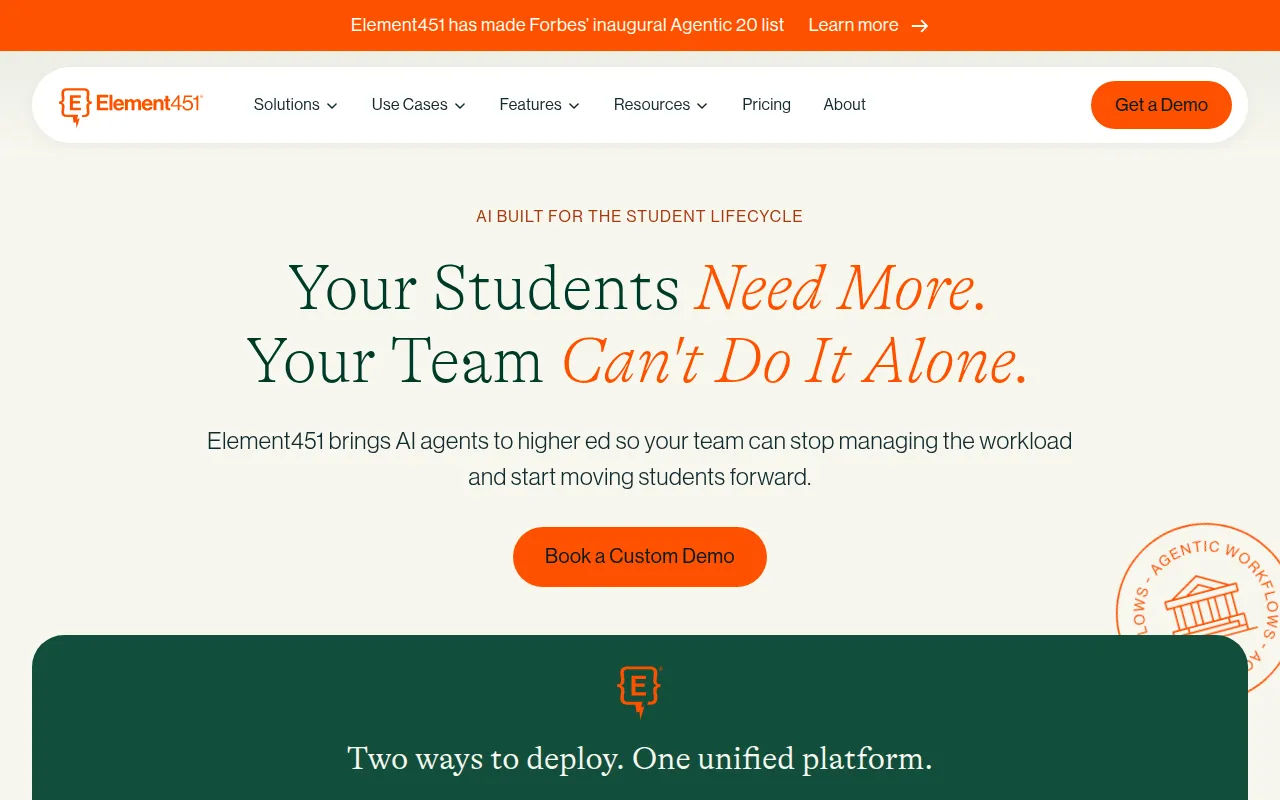
Element451 is an AI-first CRM and student engagement platform built for higher education. Its Bolt agents answer student questions, its engagement tools cover email, text and voice, and onboarding, chat support and an account manager come with every plan. Pricing starts at $20,000 a year, based on enrolled students and support tier, with special pricing available for community colleges by inquiry. Element451 fits a college whose team is too small to run a system like Slate. The vendor handles onboarding and support, and the AI agents do work that would otherwise need extra staff. The weakness is pricing detail: only the floor is published, so the real contract figure comes from a quote, and texting and voice are billed by usage on top.
Starting price: From $20,000 a year. Free plan: No. Skip if your budget is under $20,000 a year or you need line-item pricing before a sales call.
 Ellucian CRM Advance: best for advancement and alumni fundraising teams
Advance is a constituent relationship management product for nonprofit advancement: donor cultivation, gift processing, alumni engagement and fundraising reporting, built to sit beside Ellucian's student systems. Ellucian publishes no price for it, so budgeting starts with a quote.
Starting price: Pricing on request. Free plan: No. Skip if you need a published price or an admissions CRM; this one serves advancement only.
 Freshsales: best for small teams wanting a simple pipeline
Freshsales fits a small recruitment or outreach team that wants a clean pipeline and nothing else. Freshsales, from Freshworks, starts at $9 a user a month billed annually on Growth, with Pro at $39 and Enterprise at $59. Growth covers kanban pipelines, contact lifecycle stages, email and chat, and basic workflows. The weakness is the same as Zoho's, sharper: no admissions features, no event management worth the name, and the AI agent add-on is billed per 100 sessions. Growth covers a Kanban pipeline, lifecycle stages, built-in chat, email and phone, templates, custom fields and basic workflows. Pro adds contact scoring, deal insights, territory management and sales sequences. Freshsales fits inside sales teams that live on the phone, because the dialer ships with the product instead of arriving as a separate contract. Freshworks also lists a free edition for up to 3 users on its comparison table, but its pricing page leads with paid plans, so confirm the free edition at signup rather than budgeting around it. Skip Freshsales if you need deep reporting or a large integration library on day one. Its ecosystem is smaller than HubSpot's or Zoho's.
Starting price: From $9 a user a month billed annually (Growth). Free plan: No, 21-day free trial. Skip if you need higher education features like events and application tracking built in.
 HubSpot: best for small admissions and marketing teams
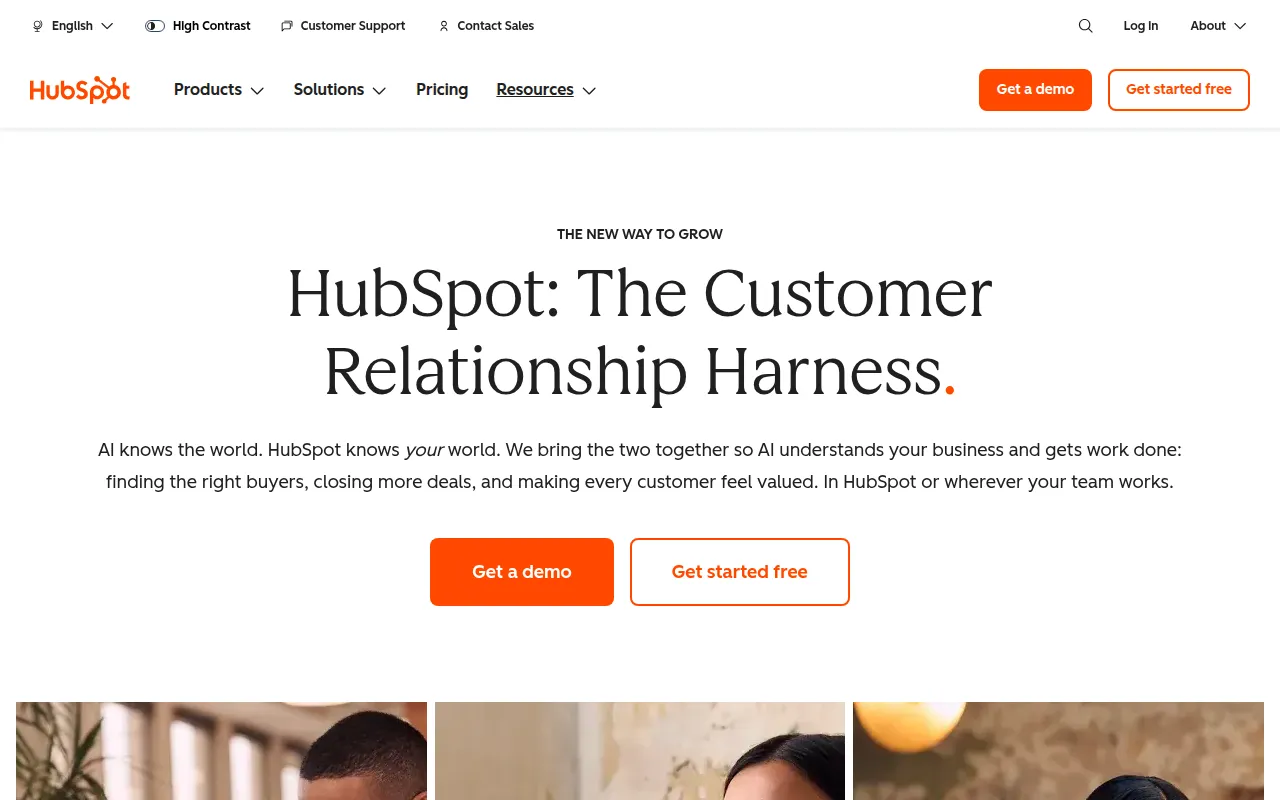
HubSpot also runs nonprofit discount programmes for eligible institutions. Professional costs $90 a seat a month billed annually and adds automation, sequences and forecasting, plus a one-time $1,500 onboarding fee. HubSpot fits a small college or a single programme that needs contact management, email and a pipeline fast, with no implementation project. The weakness is that nothing about it is built for admissions: application reading, decision release and counselor territories all need custom objects or third-party tools, and the per-seat price climbs quickly once Professional is needed. HubSpot's Sales Hub is free for up to 2 users. It includes up to 1,000 fully customizable workflows, deal and quote approvals, predictive lead scoring, recurring revenue tracking, advanced permissions and 5,000 HubSpot Credits a month, which pay for AI agents and some automated features. HubSpot fits teams whose pipeline starts in marketing and who want sales, marketing and service data in one place without building integrations. HubSpot's free CRM covers up to 2 users and 1,000 contacts, with contact and deal management, forms, live chat and a meeting link. Marketing Hub at higher tiers adds multi-event attribution and list segmentation at scale.
Starting price: From $20 a seat a month (Sales Hub Starter, list rate). Free plan: Yes, free CRM. Skip if you need admissions workflows like application reading out of the box.
 Slate: best for admissions-led colleges and universities
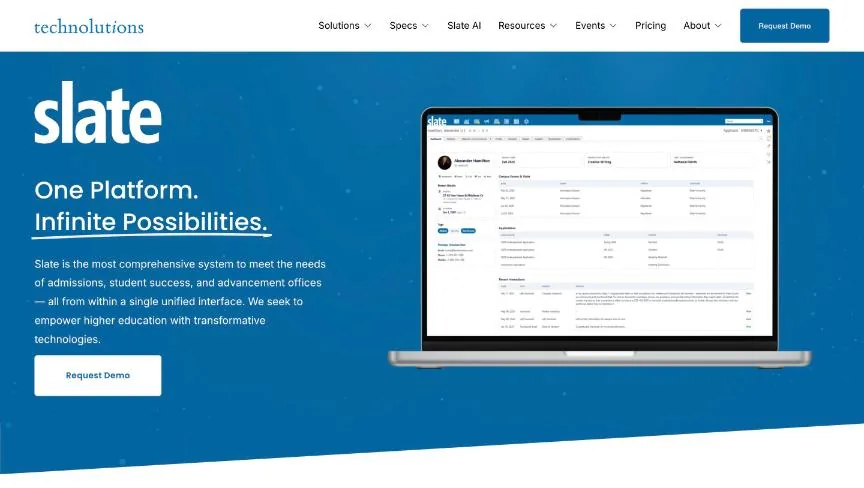
Slate's strength is depth and transparency. Technolutions is the admissions CRM most US colleges compare everything else against. It covers the full admissions lifecycle: inquiry and application processing, communication flows, event management, counselor territory assignments, application reading and decision release. It is licensed per institution, not per user, so a large admissions team does not pay more as headcount grows. The published licence starts at $30,000 a year for fewer than 1,500 applications and rises with volume to $175,000 a year; Technolutions says most clients pay around $50,000 a year. The licence model is published, the platform is built only for higher education, and student success work inside the same database adds no extra licence cost. The weakness is the staffing demand: Slate expects a dedicated staff member to build and maintain it, and each separately run programme is priced by its own application volume.
Starting price: From $30,000 a year (institutional licence). Free plan: No. Skip if your budget is under $30,000 a year or no one on staff can own the system.
 Zoho CRM: best for small programmes on a tight budget
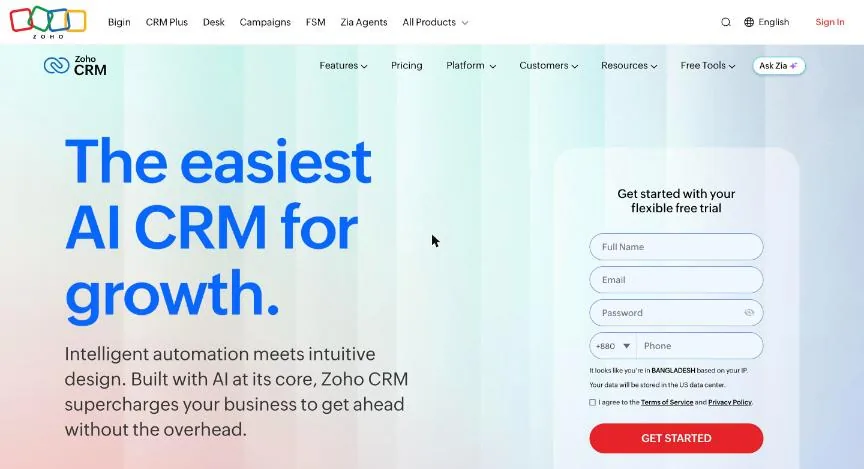
Zoho CRM is free for up to 3 users, with paid editions at $14 a user a month for Standard, $23 for Professional and $40 for Enterprise, all billed annually. Standard adds email integration, calling and forecasting; Professional adds process automation and inventory; Enterprise adds territory management and the Zia AI assistant. Zoho fits a continuing education programme or a small department that needs a real pipeline for a few hundred dollars a year. The weakness is fit: it is a sales CRM, so admissions workflow, events and SIS connections are custom work, and the free edition caps at 3 users with only the essentials. Standard adds email integration, mass email, built-in calling, up to 5 pipelines and forecasting. Professional adds process management through Blueprint, CPQ, inventory and portals. Zoho wins on value per dollar and on breadth at low prices. The weakness is the learning curve: settings are spread across many screens, and support tiers and storage are priced separately, so the invoice can exceed the headline plan price. Skip Zoho if your team wants the simplest possible setup and will not use its wider app suite.
Starting price: From $14 a user a month billed annually (Standard). Free plan: Yes, free for up to 3 users. Skip if you need native application processing or SIS integration without custom work.
Which Salesforce Education Cloud alternative fits which need
- Lean teams wanting AI student engagement: Element451, From $20,000 a year.
- Advancement and alumni fundraising teams: Ellucian CRM Advance, Pricing on request.
- Small teams wanting a simple pipeline: Freshsales, From $9 a user a month billed annually (Growth).
- Small admissions and marketing teams: HubSpot, From $20 a seat a month (Sales Hub Starter, list rate).
- Admissions-led colleges and universities: Slate, From $30,000 a year (institutional licence).
- Small programmes on a tight budget: Zoho CRM, From $14 a user a month billed annually (Standard).
Free plans and trials
Salesforce Education Cloud: No, free trial available. The alternatives:
- Element451: No.
- Ellucian CRM Advance: No.
- Freshsales: No, 21-day free trial.
- HubSpot: Yes, free CRM.
- Slate: No.
- Zoho CRM: Yes, free for up to 3 users.
What to check before you choose
The same five checks apply to every tool on this page, and they matter more than the starting price.
- Price at your real seat count. Most CRMs charge per user per month, and the plan you need is often one tier above the entry plan. Multiply the price of that tier by the people who will log in, then add any onboarding fee.
- Where the limits sit. Check the caps on contacts, pipelines, custom fields, automations and email sends on the plan you would buy. A cheap plan with one pipeline is not cheap if you run three.
- How it fits the way you sell. A team that sells by phone needs calling and logging. A team that sells by email needs sequences and tracking. Pick the tool built around your main channel.
- Integrations you already depend on. List your email, calendar, accounting and form tools, then confirm each one connects natively. A connection through a third-party automation tool adds cost and one more thing to break.
- Reporting you will actually read. Ask for the pipeline, forecast and activity reports on the plan you would buy. Advanced reporting is one of the most common features held back for higher tiers.
What switching from Salesforce Education Cloud involves
Moving CRMs is mostly a data job. Export contacts, companies, deals, notes and activity history as CSV files, and check that the new tool can import each one with its links intact, so a deal still points to its contact and company. Custom fields need to be created in the new tool before the import. Automations, email templates and reports do not transfer and have to be rebuilt. Plan for a short overlap in which both systems run, and pick a quiet week in your sales cycle for the cut-over. If you are on an annual contract with Salesforce Education Cloud, check the renewal date and notice period first.
Mistakes to avoid
Do not switch on headline price alone. The starting prices here use different units (per user, per contact, per site), so price each alternative at your own usage, and check which features sit on the plan you would actually buy.
Quick answers
Element451 vs Ellucian CRM Advance: which one should you choose?
Element451 is the better fit for lean teams wanting AI student engagement. Ellucian CRM Advance is the better fit for advancement and alumni fundraising teams. Element451 pricing: From $20,000 a year. Ellucian CRM Advance does not publish prices; pricing is on request.
Which of these alternatives has a free plan?
HubSpot and Zoho CRM offer a free plan. Freshsales offers a free trial instead. Checked 14 November 2026.
How much does Element451 cost?
Element451 pricing: From $20,000 a year. Checked 14 November 2026 against the vendor's own page.
How much does Ellucian CRM Advance cost?
Ellucian CRM Advance does not publish prices; pricing is on request. Checked 14 November 2026 against the vendor's own page.
How much does Freshsales cost?
Freshsales pricing: From $9 a user a month billed annually (Growth). Free plan: No, 21-day free trial. Checked 14 November 2026 against the vendor's own page.
Which alternative is best for small teams wanting a simple pipeline?
Freshsales. Pricing: From $9 a user a month billed annually (Growth). Free plan: No, 21-day free trial. Skip if you need higher education features like events and application tracking built in.
Which alternative is best for small admissions and marketing teams?
HubSpot. Pricing: From $20 a seat a month (Sales Hub Starter, list rate). Free plan: Yes, free CRM. Skip if you need admissions workflows like application reading out of the box.
Which alternative is best for admissions-led colleges and universities?
Slate. Pricing: From $30,000 a year (institutional licence). Skip if your budget is under $30,000 a year or no one on staff can own the system.
What is the catch with the Zoho CRM free plan?
The free plan covers: free for up to 3 users. Paid pricing: From $14 a user a month billed annually (Standard). Checked 14 November 2026.
Common questions
What is the best alternative to Salesforce Education Cloud?
It depends on what you need. Element451 suits lean teams wanting AI student engagement, Ellucian CRM Advance suits advancement and alumni fundraising teams, and Freshsales suits small teams wanting a simple pipeline.
How much does Salesforce Education Cloud cost?
Salesforce Education Cloud pricing: From $87 a user a month billed annually (nonprofit pricing). Free plan: No, free trial available. Checked 2026-11-14 against the vendor's page.
Is there a free alternative to Salesforce Education Cloud?
Yes. HubSpot and Zoho CRM have a free plan. Check the limits before you rely on one.
How were these Salesforce Education Cloud alternatives chosen?
They are the products Adziq already compares alongside Salesforce Education Cloud, with prices read from each vendor's pricing page.
Did Adziq test these products?
No. This comparison uses each vendor's published pricing and documentation, checked on the dates shown.
Sources
- Salesforce Education Cloud pricing
- Element451 pricing
- Ellucian CRM Advance pricing
- Freshsales pricing
- HubSpot pricing
- Slate pricing
- Zoho CRM pricing
How we research, check prices and label sponsored listings: editorial policy. To feature a product or agency, ask about a listing.