
The short answer
Amplitude is the closest Mixpanel alternative and has the larger free plan: 2 million events a month against Mixpanel's 1 million. PostHog is the best choice for a small product team that wants analytics, session replay and feature flags on one usage-based bill with no base fee. Heap suits teams that do not want to plan tracking in advance. For website traffic, not product usage, Google Analytics 4 is free and Plausible starts at $9 a month.
Key takeaways
- Mixpanel is free up to 1 million events a month; Growth starts at $140 a month billed monthly, or $100 billed annually.
- Amplitude's free plan covers 2 million events a month with unlimited seats.
- PostHog has no base fee or seat fees: 1 million events a month are free, and usage beyond that is billed as you go.
- Heap and Pendo publish no prices for paid plans.
- Google Analytics 4 is free; Matomo Cloud starts at $26 a month and Plausible at $9 a month billed annually.
What Mixpanel does well, and why people leave
Mixpanel is a product analytics platform that tracks events, not page views. An event is something a user does, such as signing up, upgrading or completing a checkout. Funnels show where users drop out and retention curves show who comes back. The free plan covers up to 1 million events a month. Growth starts at $140 a month billed monthly, or $100 billed annually, at the 1.5 million-event tier, and scales to $2,289 a month at 20 million events. Enterprise is priced on request.
People leave for two reasons. The bill grows with event volume, and a busy product produces events quickly. And Mixpanel only knows what you told it to track, so a question about an action nobody instrumented cannot be answered.
Four of the tools below are product analytics platforms like Mixpanel. Three are website analytics tools, for readers who discover that page-level reporting is all they needed. Prices come from each vendor's pricing page, checked on 13 and 14 November 2026. No hands-on testing was done.
How we chose
We separated two jobs that are often confused: understanding what users do inside a product, and understanding where website visitors come from. For each tool we noted the free allowance, the unit it charges on (events, sessions, users, hits or pageviews) and whether paid prices are published.
1. Amplitude: best for the same product analytics with a larger free plan
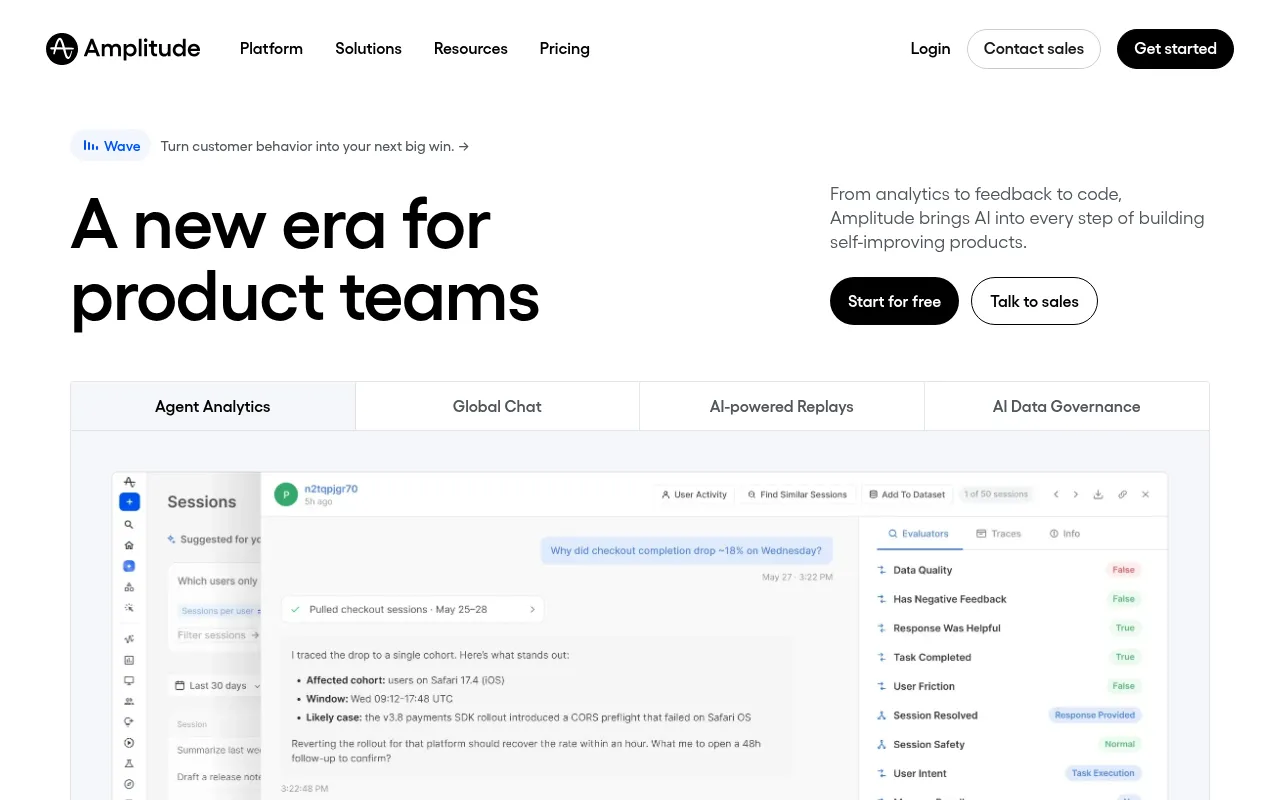
Amplitude Free covers 2 million events a month with no time limit, 10,000 session replays a month and unlimited seats. Plus also starts at $0, because the first 2 million events are free, and scales up to 70 million events. Growth and Enterprise are custom-priced.
Amplitude is the direct swap: behavioural cohorts, journey analysis and experimentation on the same event data. The free plan is twice Mixpanel's. Beyond it, Plus does not publish a per-event rate, so you cannot budget without a quote.
2. PostHog: best for analytics, replay and feature flags on one bill
PostHog has no base fee and no seat fees. Each month includes 1 million product analytics events free, and usage beyond the free allowance is billed as you go. PostHog has changed how it meters usage, so read the current rates on its pricing page before you estimate a bill.
One account covers product analytics, session replay, feature flags, experiments and surveys, each with its own free allowance. A small product can run all of them and pay little or nothing. The bill moves with usage, so it is less predictable than a fixed plan.
3. Heap: best for teams that do not want to plan tracking in advance
Heap captures web and mobile interactions automatically. The free plan covers 10,000 sessions a month with 6 months of history and session replay. Growth, Pro and Premier publish no prices.
Because every click and page view is recorded from the start, Heap can answer questions about flows nobody thought to instrument. That directly fixes Mixpanel's second weakness. Heap is owned by Contentsquare, and paid pricing requires a sales conversation.
4. Pendo: best for analytics plus in-app guides
Pendo Free covers up to 500 monthly active users, with product analytics, in-app guides, roadmaps and NPS surveys. Paid plans are priced on request and sold on annual contracts.
Pendo lets you see where users struggle and then put a guide or walkthrough in front of them, without a second product. Five hundred monthly active users is a trial-sized limit, and session replay is not on the free plan.
5. Google Analytics 4: best for website traffic and campaigns, free
Google Analytics 4 is free in its standard version. It records traffic from search, ads, social, email and direct visits in one place and connects to Google Ads at no cost.
If your Mixpanel dashboards were really about traffic sources and landing pages, GA4 covers that for nothing. It is not built for analysing signed-in product behaviour, and its event setup takes time to get right.
6. Matomo: best for full data ownership
Matomo is open-source analytics, sold as a hosted cloud service or as free software you run yourself. Matomo Cloud starts at $26 a month for up to 50,000 hits and $42 for 100,000. A Cloud plan includes up to 30 websites and 30 team members.
Choose Matomo when data must stay under your control, for example for privacy or contractual reasons. Goals, funnels, heatmaps and session recording are available on higher tiers. Self-hosting is free but needs someone to maintain the server.
7. Plausible Analytics: best for simple, cookieless website analytics
Plausible starts at $9 a month billed annually for up to 10,000 monthly pageviews, and $19 a month at 100,000. All plans include unlimited websites. There is a 30-day trial and no permanent free cloud plan.
Plausible tracks pageviews, referrers, campaigns, goals and custom events without cookies or personal data, on a single-screen dashboard. It is the opposite of Mixpanel in scope, and that is the appeal for a content site.
What switching involves
Keep your tracking plan. The list of events and properties you send to Mixpanel is the most valuable thing you have. Reuse the same names in the new tool.
Run both for a month. Send events to the old and new tools in parallel and compare totals before trusting the new numbers.
Expect history to stay behind. Most teams start the new tool from the day of the switch. Export key Mixpanel reports first.
Check the billing unit. Events, sessions, monthly active users, hits and pageviews are not comparable. Estimate your own monthly volume in the new tool's unit before choosing.
Mixpanel Alternatives at a glance
| Pick | Best for | Starting price | Free plan |
|---|---|---|---|
| Amplitude | The same product analytics with a larger free plan | $0 for Free; Plus starts at $0 with 2M events free | Yes, 2M events a month |
| PostHog | Analytics, replay and feature flags on one bill | $0 base fee; 1 million events a month free, then usage-based | Yes, 1M events a month |
| Heap | Teams that do not want to plan tracking in advance | Free up to 10,000 sessions a month; paid plans pricing on request | Yes |
| Pendo | Analytics plus in-app guides | Free $0 up to 500 MAU; paid plans pricing on request | Yes, up to 500 monthly active users |
| Google Analytics 4 | Website traffic and campaigns, free | Free | Yes |
| Matomo | Full data ownership | From $26 per month (Matomo Cloud, up to 50,000 hits) | Yes, self-hosted Community edition |
| Plausible Analytics | Simple, cookieless website analytics | From $9 per month (billed annually, up to 10,000 pageviews) | No, 30-day trial |
Quick answers
Amplitude vs PostHog: which one should you choose?
Amplitude is the better fit for the same product analytics with a larger free plan. PostHog is the better fit for analytics, replay and feature flags on one bill. Amplitude pricing: $0 for Free; Plus starts at $0 with 2M events free. PostHog pricing: $0 base fee; 1 million events a month free, then usage-based.
Which of these alternatives has a free plan?
Amplitude, PostHog, Heap, Pendo, Google Analytics 4 and Matomo offer a free plan. Plausible Analytics offers a free trial instead. Checked 14 November 2026.
How much does Amplitude cost?
Amplitude pricing: $0 for Free; Plus starts at $0 with 2M events free. Free plan: Yes, 2M events a month. Checked 14 November 2026 against the vendor's own page.
How much does PostHog cost?
PostHog pricing: $0 base fee; 1 million events a month free, then usage-based. Free plan: Yes, 1M events a month. Checked 14 November 2026 against the vendor's own page.
How much does Heap cost?
Heap pricing: Free up to 10,000 sessions a month; paid plans pricing on request. Free plan: Yes. Checked 14 November 2026 against the vendor's own page.
Which alternative is best for teams that do not want to plan tracking in advance?
Heap. Pricing: Free up to 10,000 sessions a month; paid plans pricing on request. Free plan: Yes. Skip if you need a published price.
Which alternative is best for analytics plus in-app guides?
Pendo. Pricing: Free $0 up to 500 MAU; paid plans pricing on request. Free plan: Yes, up to 500 monthly active users. Skip if you have more than 500 monthly active users and no budget.
Which alternative is best for website traffic and campaigns, free?
Google Analytics 4. Pricing: Free. Free plan: Yes. Skip if you need to analyse logged-in product usage.
What is the catch with the Amplitude free plan?
The free plan covers: 2M events a month. Paid pricing: $0 for Free; Plus starts at $0 with 2M events free. Checked 14 November 2026.
Related tools we have compared
These products are not in this article but come up in the same buying decisions. Prices are from our own checks of each vendor's page.
- Brevo: automation on the smallest budget. Starter from $9 per month (5,000 emails a month, monthly billing). Compared in Best ActiveCampaign Alternatives: 7 Automation Tools Compared.
- Attio: cheaper relationship-first CRM. $100 per month (Pro workspace, billed annually) plus $79 per extra user. Compared in Affinity CRM Talent Teams Alternatives: 6 Picks.
- DashThis: simple dashboards priced per dashboard. From $44 a month (Individual, 3 dashboards). Compared in Agency Analytics Alternatives: 6 Cheaper and Simpler Options.
- Semrush: a broader suite with daily rank tracking. $139 per month (SEO plan); $199 per month with AI search tracking. Compared in Best Ahrefs Alternatives: 6 Tools for Backlinks and SEO.
- Hunter: verified email addresses and simple outreach. From $49 per month, or $34 per month billed annually. Compared in Best Apollo.io Alternatives: 7 Sales Data Tools Compared.
- Zoho CRM: cheaper full CRM. Free plan; Standard $14 per user per month billed annually. Compared in 7 CRM HubSpot Alternatives That Cost Less or Do More.
- Fathom Analytics: many sites on one subscription. From $15 per month (up to 100,000 pageviews). Compared in 6 Best Cookieless Tracking Marketing Software for 2026.
- Cloudflare Web Analytics: a permanent free plan. Free on all Cloudflare plans. Compared in Best Free Web Analytics Tools: 7 Compared.
Common questions
What is the best free alternative to Mixpanel?
Amplitude, with 2 million events a month free and unlimited seats. PostHog gives 1 million events a month free with session replay and feature flags included. Google Analytics 4 is free for website and campaign reporting.
Is Amplitude better than Mixpanel?
They do the same core job. Amplitude's free plan is twice the size and includes its other modules at limited volumes. Mixpanel publishes its paid pricing, from $140 a month at 1.5 million events, where Amplitude prices higher volumes by quote.
Is PostHog cheaper than Mixpanel?
For a small product, usually. PostHog has no base fee and no seat fees, includes 1 million events a month free, and bills usage beyond that as you go; check its pricing page for current rates. Mixpanel Growth starts at $140 a month billed monthly.
Can Google Analytics replace Mixpanel?
Only for website traffic. Google Analytics 4 reports where visitors come from and what they do on a site. Mixpanel is built to analyse what signed-in users do inside a product: funnels, retention and cohorts.
Why do people leave Mixpanel?
Mostly cost at scale and setup effort. Growth reaches $2,289 a month at 20 million events on monthly billing, and every event has to be defined and instrumented before it can be analysed.
Sources
- Mixpanel pricing
- Amplitude pricing
- PostHog pricing
- Heap pricing
- Pendo pricing
- Google Analytics 4 pricing
- Matomo pricing
- Plausible Analytics pricing
How we research, check prices and label sponsored listings: editorial policy. To feature a product or agency, ask about a listing.