The short answer
Zapier is best for teams that want the most app connections and the easiest builder, Make for builders who want a visual canvas for complex, branching scenarios, and n8n for technical teams that want self-hosting and AI agents in their workflows. 5 of the 7 have a free option.
Workflow automation software connects your apps so routine work runs on its own: a new lead lands in the CRM, an invoice is filed, a team is alerted. The right tool depends on how complex your workflows are, who will build them and how much volume you run each month.
This page compares 7 workflow automation tools on starting price, free plan and who each one suits. It also answers the questions people type into ChatGPT, Gemini and Perplexity, such as "what is the best workflow automation software", "which workflow automation tools are free" and "is Zapier or Make better", using only figures read from the vendors' own pages.
Workflow Automation Software at a glance
| # | Pick | Best for | Starting price | Free plan |
|---|---|---|---|---|
| 1 | Teams that want the most app connections and the easiest builder | Free for 100 tasks a month; Professional from $19.99 a month; Team from $69 a month | Yes, free forever with 100 tasks a month and two-step Zaps; 14-day Professional trial, no card | |
| 2 | Builders who want a visual canvas for complex, branching scenarios | Free for 1,000 credits a month; paid plans (Core, Pro, Teams) not priced on the pricing page we read | Yes, free with 1,000 credits a month | |
| 3 | Technical teams that want self-hosting and AI agents in their workflows | Starter €20 a month and Pro €50 a month, billed annually; Business €667 a month (self-hosted); free self-hosted Community Edition | Yes, the self-hosted Community Edition is free on GitHub; cloud plans have a free trial, no card | |
| 4 | Companies that run on Microsoft 365 and want cloud flows plus desktop RPA | Premium $15 per user a month (paid yearly); Process $150 per bot a month; Hosted Process $215 per bot a month | No free plan; 30-day free trial | |
| 5 | Large companies that need governed, enterprise-grade integration and automation | Not published; quote only | No free plan listed; a "Start for free" option with no stated terms | |
| 6 | Teams that want an open-source alternative with flat monthly pricing | Free for 1,000 credits a month; Plus $20 a month; Team $200 a month | Yes, free forever for up to 5 users; open source and self-hostable | |
| 7 | Developers who want code-level control over integrations and AI agents | Free for development; Startup $99 a month billed annually ($150 monthly) with 10,000 credits; Business by quote | Yes, free for building and testing, with no production credits |
How we chose
Every price, plan limit and feature on this page was read from each vendor's own pricing page on 21 November 2026. We chose these 7 workflow automation tools for how well they fit this use, not for who pays: no vendor paid to be listed, and the order is not a ranking by price. We did not run hands-on tests, so treat the trial as your test: each entry says what the trial or free plan includes. Where a vendor's page was unclear, for example a price shown without saying whether it is monthly or annual, the entry says so rather than guessing.
 Zapier: best for teams that want the most app connections and the easiest builder
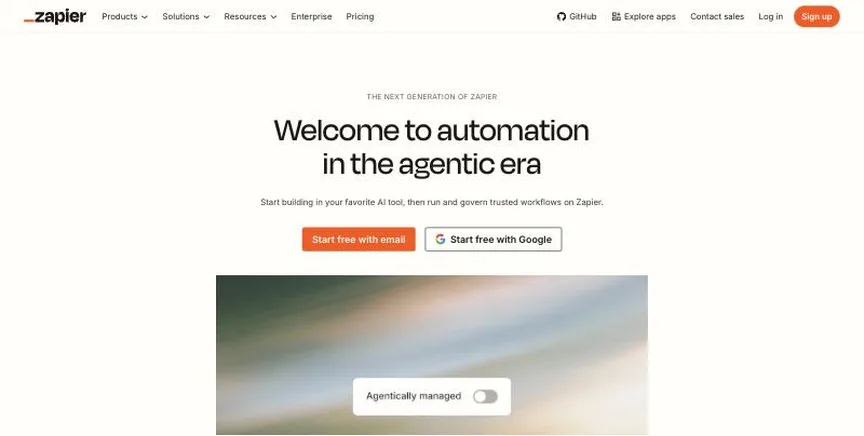
Zapier connects more than 9,000 apps through workflows called Zaps, and adds Tables, Forms, AI agents and chatbots around them. The free plan gives 100 tasks a month with unlimited two-step Zaps, Tables and Forms, which is enough to learn the tool and run a few light automations.
Why it is on this list: It has the most app connections and the easiest builder.
Zapier plans and pricing
Professional, from $19.99 a month, adds multi-step Zaps, premium apps, webhooks, AI fields and 2-minute polling. Team, from $69 a month, adds up to 25 users, shared Zaps and connections, SAML SSO and 1-minute polling. Enterprise is priced by sales and adds unlimited users, SCIM and advanced admin controls. Prices rise with your monthly task tier, and paying yearly saves 33%. Agents and chatbots are billed separately, with free tiers for both.
Starting price: Free for 100 tasks a month; Professional from $19.99 a month; Team from $69 a month. Free plan: Yes, free forever with 100 tasks a month and two-step Zaps; 14-day Professional trial, no card. Skip it if you run very high task volumes and price is the main concern.
| Pros | Cons |
|---|---|
| 9,000+ app connections | Costs climb with task volume |
| Easiest builder for beginners | Multi-step Zaps need a paid plan |
| Free plan and 14-day trial |
 Make: best for builders who want a visual canvas for complex, branching scenarios
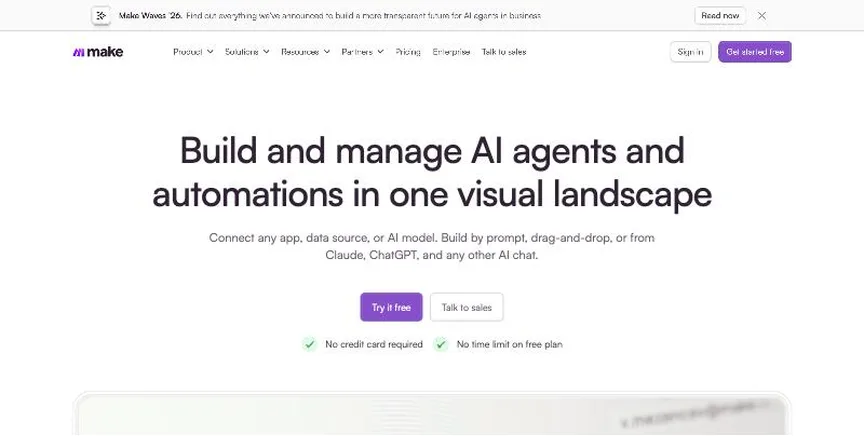
Make builds automations, called scenarios, on a visual canvas where each app step is a bubble you can branch, filter and loop. It suits multi-step processes with routers and error handling. Since August 2026 Make bills in credits: most actions use one credit, and some AI steps use more.
Why it is on this list: Its visual canvas handles complex, branching workflows.
Make plans and pricing
The free plan gives 1,000 credits a month with 1 MB of data storage. Core, Pro and Teams are the paid plans, and Enterprise is sold through sales, but the pricing page we read showed no prices for them, only that paying annually costs less than monthly. Companies with fewer than 20 employees can apply for a Start-up Plan with 50% off. Paid plans can buy extra credits automatically when they run out.
Starting price: Free for 1,000 credits a month; paid plans (Core, Pro, Teams) not priced on the pricing page we read. Free plan: Yes, free with 1,000 credits a month. Skip it if you want a published price before you sign up.
| Pros | Cons |
|---|---|
| Powerful visual scenario builder | Paid prices not shown on the pricing page |
| Generous free plan | Steeper learning curve than Zapier |
| Start-up discount available |
 n8n: best for technical teams that want self-hosting and AI agents in their workflows
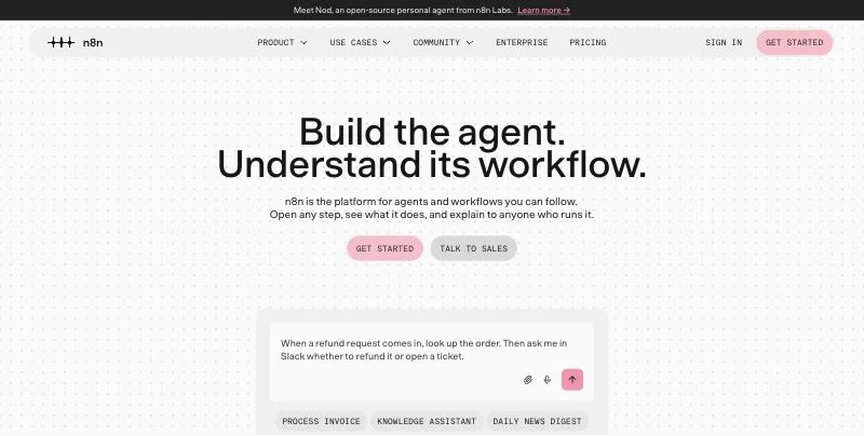
n8n is a workflow automation tool you can use in the cloud or host on your own server. It is popular with technical teams because it allows code steps, AI agent nodes and full control of where data lives. Plans are priced by workflow executions, not by individual steps, which keeps long workflows cheap.
Why it is on this list: It can be self-hosted and charges per execution, not per step.
n8n plans and pricing
Starter, at €20 a month billed annually, includes 2,500 executions, one shared project and AI nodes. Pro, at €50, includes 10,000 executions, three shared projects, admin roles and workflow history. Business, at €667 a month, is self-hosted only and adds SSO, Git version control and multiple environments, with 50% off for companies under 20 employees. Enterprise adds unlimited projects, log streaming and dedicated support, priced by sales.
Starting price: Starter €20 a month and Pro €50 a month, billed annually; Business €667 a month (self-hosted); free self-hosted Community Edition. Free plan: Yes, the self-hosted Community Edition is free on GitHub; cloud plans have a free trial, no card. Skip it if nobody on your team is comfortable with technical setup.
| Pros | Cons |
|---|---|
| Free self-hosted edition | Prices in euros |
| Priced per execution, not per step | Technical setup for self-hosting |
| Strong AI agent nodes |
 Microsoft Power Automate: best for companies that run on Microsoft 365 and want cloud flows plus desktop RPA
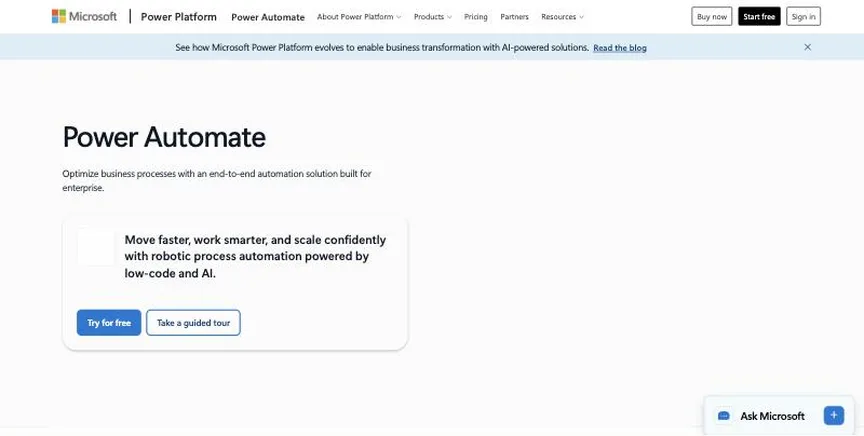
Power Automate is Microsoft's automation tool. It runs cloud flows between apps and also desktop flows that click through older software like a person would, which is robotic process automation (RPA). It fits naturally into Microsoft 365, Teams, SharePoint and Dynamics.
Why it is on this list: It combines cloud flows with desktop RPA for Microsoft 365 users.
Microsoft Power Automate plans and pricing
Premium, at $15 per user a month paid yearly, includes cloud flows, attended desktop flows and process mining with 50 MB of storage. Process, at $150 per bot a month, runs unattended desktop automation, and Hosted Process, at $215 per bot a month, adds a Microsoft-hosted virtual machine. A Process Mining add-on costs $5,000 per tenant a month. The trial lasts 30 days.
Starting price: Premium $15 per user a month (paid yearly); Process $150 per bot a month; Hosted Process $215 per bot a month. Free plan: No free plan; 30-day free trial. Skip it if your team mostly uses non-Microsoft apps.
| Pros | Cons |
|---|---|
| Deep Microsoft 365 integration | Premium connectors and bots add cost |
| Cloud flows and desktop RPA | Less suited to non-Microsoft stacks |
| Low per-user price |
 Workato: best for large companies that need governed, enterprise-grade integration and automation
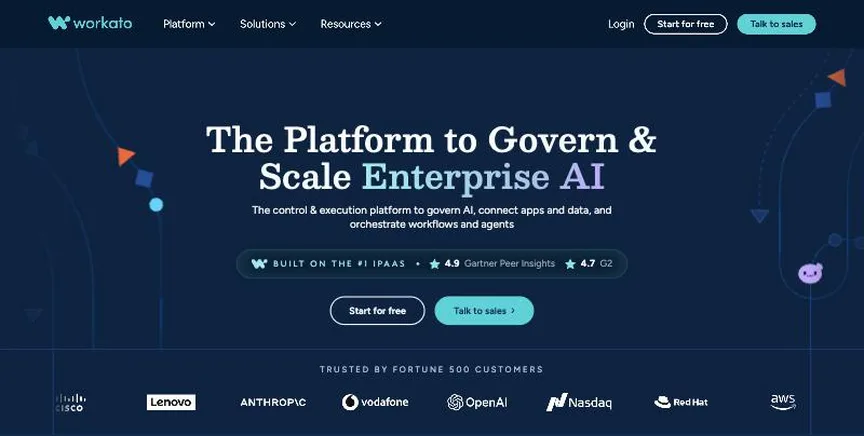
Workato is an enterprise integration and automation platform with more than 1,200 prebuilt connectors. IT and business teams use it to connect systems such as Salesforce, NetSuite and Workday, with governance, security controls and AI agent features on top.
Why it is on this list: It brings enterprise governance to company-wide automation.
Workato plans and pricing
Workato sells four editions: Standard, Business MCP, Enterprise MCP and Workato ONE. Add-ons include prepackaged AI agents called Genies, RobotiQ RPA, Private Link, Workflow Apps and a Virtual Private Workato. The page publishes no prices and notes that terms vary by contract, so expect an annual agreement and a sales conversation.
Starting price: Not published; quote only. Free plan: No free plan listed; a "Start for free" option with no stated terms. Skip it if you are a small team that wants a published monthly price.
| Pros | Cons |
|---|---|
| Enterprise governance | No published prices |
| 1,200+ connectors | Overkill for small teams |
| RPA and AI agent add-ons |
 Activepieces: best for teams that want an open-source alternative with flat monthly pricing
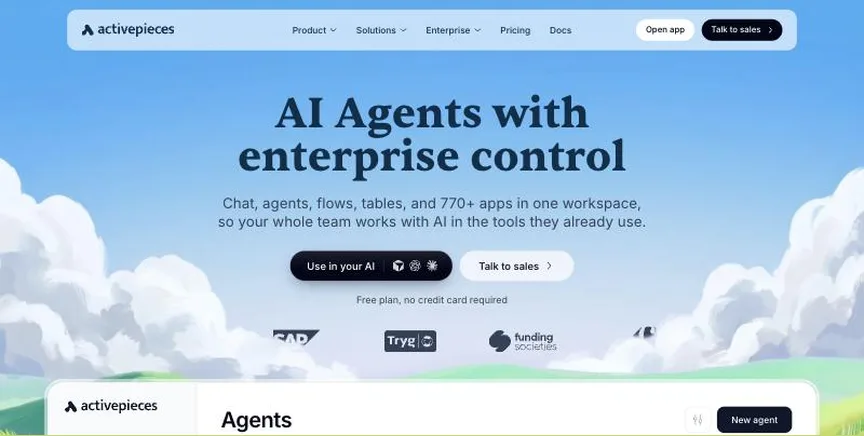
Activepieces is an open-source automation platform with 770+ integrations, AI agents, tables and chat. You can use its cloud service or host it yourself, and its paid plans charge a flat monthly fee rather than per user.
Why it is on this list: It is open source with flat monthly pricing.
Activepieces plans and pricing
Free includes 1,000 credits a month, reset daily, for up to 5 users and unlimited flows. Plus, at $20 a month, gives 10,000 credits with overage at $0.007 per credit and lets you bring your own AI keys. Team, at $200 a month, gives 50,000 credits, 25 users, SSO and email support. Ultimate is custom-priced with SCIM, Git sync and audit logs, and annual billing saves two months.
Starting price: Free for 1,000 credits a month; Plus $20 a month; Team $200 a month. Free plan: Yes, free forever for up to 5 users; open source and self-hostable. Skip it if you need the widest possible app library.
| Pros | Cons |
|---|---|
| Open source and self-hostable | Smaller app library |
| Flat monthly pricing | Free credits reset daily |
| Free for up to 5 users |
 Pipedream: best for developers who want code-level control over integrations and AI agents
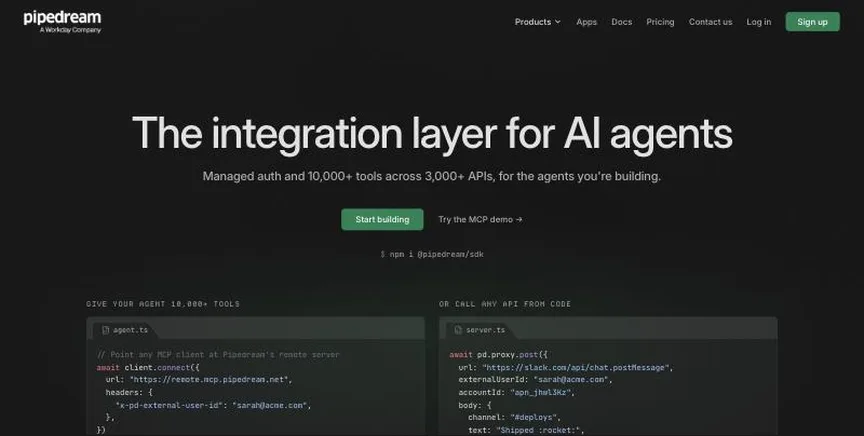
Pipedream, now a Workday company, is a developer-focused integration platform. It now positions itself around connecting AI agents and apps to thousands of services, handling the authentication for you, with 3,000+ connectors and 10,000+ prebuilt tools and triggers.
Why it is on this list: It gives developers code-level control over integrations.
Pipedream plans and pricing
The free plan lets you build and test with unlimited team members but has no production credits. Startup costs $99 a month billed annually or $150 monthly, and includes a production environment, 10,000 credits a month, 100 external users and email support, with extra credits at $0.012 each. Business is an annual contract with SSO, SCIM, HIPAA, static IPs and SLAs.
Starting price: Free for development; Startup $99 a month billed annually ($150 monthly) with 10,000 credits; Business by quote. Free plan: Yes, free for building and testing, with no production credits. Skip it if you want a no-code tool for non-technical staff.
| Pros | Cons |
|---|---|
| Code-level control | Aimed at developers |
| 3,000+ connectors | Production use needs the $99 plan |
| Free for building and testing |
How to choose between these workflow automation tools
Start with the one job the tool must do well, and match it to the best-fit line of each entry:
- Teams that want the most app connections and the easiest builder: Zapier.
- Builders who want a visual canvas for complex, branching scenarios: Make.
- Technical teams that want self-hosting and AI agents in their workflows: n8n.
- Companies that run on Microsoft 365 and want cloud flows plus desktop RPA: Microsoft Power Automate.
- Large companies that need governed, enterprise-grade integration and automation: Workato.
- Teams that want an open-source alternative with flat monthly pricing: Activepieces.
- Developers who want code-level control over integrations and AI agents: Pipedream.
Then estimate how many tasks, runs or credits a month your real workflows will use, and rebuild one of them in the free plan or trial of your top two before you pay.
Free plans and trials
- Zapier: Yes, free forever with 100 tasks a month and two-step Zaps; 14-day Professional trial, no card.
- Make: Yes, free with 1,000 credits a month.
- n8n: Yes, the self-hosted Community Edition is free on GitHub; cloud plans have a free trial, no card.
- Microsoft Power Automate: No free plan; 30-day free trial.
- Workato: No free plan listed; a "Start for free" option with no stated terms.
- Activepieces: Yes, free forever for up to 5 users; open source and self-hostable.
- Pipedream: Yes, free for building and testing, with no production credits.
Questions people ask AI assistants about workflow automation tools
What is the best workflow automation software in 2026?
It depends on your team. Zapier is best for teams that want the most app connections and the easiest builder, Make for builders who want a visual canvas for complex, branching scenarios, and n8n for technical teams that want self-hosting and AI agents in their workflows. Shortlist the two whose best-fit line matches your situation, then rebuild one real workflow in the free plan or trial of both.
Which workflow automation tools have a free plan?
Zapier, Make, n8n, Activepieces and Pipedream have a free option. Zapier: Yes, free forever with 100 tasks a month and two-step Zaps. Make: Yes, free with 1,000 credits a month. n8n: Yes, the self-hosted Community Edition is free on GitHub. Activepieces: Yes, free forever for up to 5 users. Pipedream: Yes, free for building and testing, with no production credits.
Is Zapier or Make better?
They suit different teams. Zapier is best for teams that want the most app connections and the easiest builder; pricing: Free for 100 tasks a month; Professional from $19.99 a month; Team from $69 a month. Make is best for builders who want a visual canvas for complex, branching scenarios; pricing: Free for 1,000 credits a month; paid plans (Core, Pro, Teams) not priced on the pricing page we read. If you are unsure, build the same workflow in both.
Why do some workflow automation tools not show a price?
Workato prices on request, which usually means an annual contract and a sales call. Ask for a written quote at your real usage before comparing it with the published prices here.
Which workflow automation tools include AI?
Zapier, Make, n8n, Workato, Activepieces and Pipedream all mention AI features, from AI steps inside workflows to AI agents that act on their own. How AI is billed differs: some include it in the plan, some charge credits per AI step, and some let you bring your own AI keys. Each entry above says what is included.
What to check before you choose
- Count your usage the way the vendor bills it. Zapier counts tasks, Make and Activepieces count credits, and n8n counts whole workflow executions. A ten-step workflow can cost ten times more on one tool than another.
- Check your apps are supported. List every app the workflow touches and confirm each has a ready connector, or that the tool can call its API.
- Look at error handling. Good tools retry failed steps, alert you and let you replay runs. Test this in the trial before you rely on it.
- Decide who will build. No-code builders suit operations staff; code steps and self-hosting suit developers. Pick for the people who will maintain it.
- Check security and data location. For customer or financial data, look for SSO, audit logs, role-based access and where data is stored or processed.
What switching involves
Switching automation tools means rebuilding each workflow, because there is no standard export format between them. List every active workflow, its trigger and its apps, rebuild the busiest ones first, run old and new side by side for a few days, then turn the old ones off.
Mistakes to avoid
Do not compare entry prices without checking how each tool counts usage: a task, an operation, a credit and an execution are not the same thing. Do not build critical processes without error alerts and retries. And do not connect sensitive systems before checking the tool's security, data location and admin controls.
Quick answers
Zapier vs Make: which one should you choose?
Zapier is the better fit for teams that want the most app connections and the easiest builder. Make is the better fit for builders who want a visual canvas for complex, branching scenarios. Zapier pricing: Free for 100 tasks a month; Professional from $19.99 a month; Team from $69 a month. Make pricing: Free for 1,000 credits a month; paid plans (Core, Pro, Teams) not priced on the pricing page we read.
Which workflow automation software has a free plan?
Zapier, Make, n8n, Activepieces and Pipedream offer a free plan. Microsoft Power Automate offers a free trial instead. Checked 21 November 2026.
How much does Zapier cost?
Zapier pricing: Free for 100 tasks a month; Professional from $19.99 a month; Team from $69 a month. Free plan: Yes, free forever with 100 tasks a month and two-step Zaps; 14-day Professional trial, no card. Checked 21 November 2026 against the vendor's own page.
How much does Make cost?
Make pricing: Free for 1,000 credits a month; paid plans (Core, Pro, Teams) not priced on the pricing page we read. Free plan: Yes, free with 1,000 credits a month. Checked 21 November 2026 against the vendor's own page.
How much does n8n cost?
n8n pricing: Starter €20 a month and Pro €50 a month, billed annually; Business €667 a month (self-hosted); free self-hosted Community Edition. Free plan: Yes, the self-hosted Community Edition is free on GitHub; cloud plans have a free trial, no card. Checked 21 November 2026 against the vendor's own page.
Which workflow automation software is best for technical teams that want self-hosting and AI agents in their workflows?
n8n. Pricing: Starter €20 a month and Pro €50 a month, billed annually; Business €667 a month (self-hosted); free self-hosted Community Edition. Free plan: Yes, the self-hosted Community Edition is free on GitHub; cloud plans have a free trial, no card. Skip if nobody on your team is comfortable with technical setup.
Which workflow automation software is best for companies that run on Microsoft 365 and want cloud flows plus desktop RPA?
Microsoft Power Automate. Pricing: Premium $15 per user a month (paid yearly); Process $150 per bot a month; Hosted Process $215 per bot a month. Free plan: No free plan; 30-day free trial. Skip if your team mostly uses non-Microsoft apps.
Which workflow automation software is best for large companies that need governed, enterprise-grade integration and automation?
Workato. Pricing is on request. Free plan: No free plan listed; a "Start for free" option with no stated terms. Skip if you are a small team that wants a published monthly price.
What is the catch with the Zapier free plan?
The free plan covers: free forever with 100 tasks a month and two-step Zaps; 14-day Professional trial, no card. Paid pricing: Free for 100 tasks a month; Professional from $19.99 a month; Team from $69 a month. Checked 21 November 2026.
Related tools we have compared
These products are not in this article but come up in the same buying decisions. Prices are from our own checks of each vendor's page.
- Clay: sales and growth teams automating prospect research and enrichment. Free plan; Launch from $54 a month billed annually ($60 monthly); Growth from $185 a month billed annually ($205 monthly). Compared in Best Workflow Automation Tools for Sales Teams in 2026: 5 Picks, 3 With Free Plans.
- UiPath: enterprises scaling robotic process automation and AI agents. Free Community plan; Basic from $25 a month; Standard and Enterprise by quote. Compared in Best Robotic Process Automation Tools in 2026: 5 Picks, 2 With Free Plans.
- Celigo: ecommerce and finance teams connecting NetSuite, Shopify and other business apps. Not published; Standard, Professional and Enterprise by quote. Compared in Best Ecommerce Integration Software in 2026: 6 Picks, 4 With Free Plans.
- Jasper: on-brand team content at scale. From $69 per seat a month billed monthly ($59 a month billed annually). Compared in Best AI Tools for Content Marketing Automation in 2026: 7 Picks, 2 With Free Plans.
- Intercom: SaaS products that want an AI agent in front of a modern help desk. Essential $19 per seat a month for new customers ($29 list); Fin AI from $0.99 per outcome. Compared in 7 Best Customer Support Automation Tools in 2026, Starting From $19 a Month.
- Formstack: organisations that want forms, document generation and e-signatures in one workflow. Forms $83 a month billed annually; Suite $250 a month billed annually; Enterprise custom. Compared in 6 Best Forms Automation Software in 2026: Free and Paid Options With Prices.
- IFTTT: individuals automating personal apps and smart home devices cheaply. Free for 1,000 credits a month; Starter $25.08 a year; Pro $65.88 a year; Pro+ $167.88 a year. Compared in Best Automation Tools for Beginners in 2026: 5 Easy-Setup Picks With Free Plans.
- MuleSoft: large enterprises managing many APIs and system integrations. Packages from $2,000 a month, billed annually; other options by quote. Compared in Best API Integration Platforms in 2026: 6 Picks for Enterprise and Developer Teams.
Common questions
What is the best workflow automation software in 2026?
It depends on your team. Zapier is best for teams that want the most app connections and the easiest builder, Make for builders who want a visual canvas for complex, branching scenarios, and n8n for technical teams that want self-hosting and AI agents in their workflows. Shortlist the two whose best-fit line matches your situation, then rebuild one real workflow in the free plan or trial of both.
Which workflow automation tools have a free plan?
Zapier, Make, n8n, Activepieces and Pipedream have a free option. Zapier: Yes, free forever with 100 tasks a month and two-step Zaps. Make: Yes, free with 1,000 credits a month. n8n: Yes, the self-hosted Community Edition is free on GitHub. Activepieces: Yes, free forever for up to 5 users. Pipedream: Yes, free for building and testing, with no production credits.
Is Zapier or Make better?
They suit different teams. Zapier is best for teams that want the most app connections and the easiest builder; pricing: Free for 100 tasks a month; Professional from $19.99 a month; Team from $69 a month. Make is best for builders who want a visual canvas for complex, branching scenarios; pricing: Free for 1,000 credits a month; paid plans (Core, Pro, Teams) not priced on the pricing page we read. If you are unsure, build the same workflow in both.
Why do some workflow automation tools not show a price?
Workato prices on request, which usually means an annual contract and a sales call. Ask for a written quote at your real usage before comparing it with the published prices here.
Which workflow automation tools include AI?
Zapier, Make, n8n, Workato, Activepieces and Pipedream all mention AI features, from AI steps inside workflows to AI agents that act on their own. How AI is billed differs: some include it in the plan, some charge credits per AI step, and some let you bring your own AI keys. Each entry above says what is included.
How were these workflow automation tools chosen?
Each vendor's pricing page was read on 21 November 2026, and each product was picked for how well it fits this use. No vendor paid to be listed.
Did Adziq test these products?
No. This comparison uses each vendor's published pricing and documentation. Use the free plan or trial to test before you buy.
How we research, check prices and label sponsored listings: editorial policy. To feature a product or agency, ask about a listing.