The short answer
Akaunting is best for small businesses that want open-source accounting with an apps marketplace, GnuCash for individuals and very small businesses comfortable with a desktop app, and ERPNext for growing businesses that want open-source ERP with accounting. 3 of the 4 have a free option.
Open-source accounting software lets you see and change the code and host it yourself, so your data stays on your own server. The trade-off is setup and maintenance, which managed cloud plans from the same projects can take off your hands.
This page compares 4 open-source accounting tools on starting price, free plan and who each one suits. It also answers the questions people type into ChatGPT, Gemini and Perplexity, such as "what is the best open source accounting software", "which open-source accounting tools are free" and "is Akaunting or GnuCash better", using only figures read from the vendors' own pages.
Open Source Accounting Software at a glance
| # | Pick | Best for | Starting price | Free plan |
|---|---|---|---|---|
| 1 | Small businesses that want open-source accounting with an apps marketplace | Cloud: Standard $12 a month ($8 billed yearly); Premium $36 ($24); Elite $84 ($56); Ultimate $218 ($145) | The software is open source and free to self-host; cloud plans are paid | |
| 2 | Individuals and very small businesses comfortable with a desktop app | Free (GNU GPL) | Yes, free and licensed under the GNU GPL | |
| 3 | Growing businesses that want open-source ERP with accounting | Free to self-host (GPL-3.0); Frappe Cloud hosting from $5 a month | Yes, free to self-host under GPL-3.0 | |
| 4 | Freelancers who want a free invoicing app with self-hosting as an option | Free for up to 5 clients; Pro $14 a month ($140 a year); Enterprise from $18 a month | Yes, free for up to 5 clients with unlimited invoicing |
How we chose
Every price, plan limit and feature on this page was read from each vendor's own pricing page on 21 November 2026. We chose these 4 open-source accounting tools for how well they fit this use, not for who pays: no vendor paid to be listed, and the order is not a ranking by price. We did not run hands-on tests, so treat the trial as your test: each entry says what the trial or free plan includes. Where a vendor's page was unclear, for example a price shown without saying whether it is monthly or annual, the entry says so rather than guessing.
 Akaunting: best for small businesses that want open-source accounting with an apps marketplace
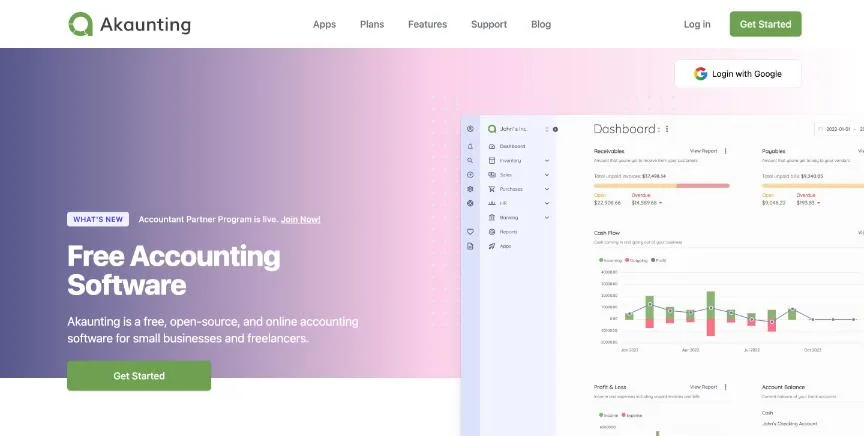
Akaunting describes itself as open-source and free accounting software, which you can self-host or use on Akaunting's cloud. Cloud Standard covers one company, one user plus an accountant, 1,000 invoices, unlimited customers and vendors, multiple currencies and four apps.
Why it is on this list: It is web-based small business accounting with an apps marketplace.
Akaunting plans and pricing
Premium covers 10 companies and 10 users and adds double-entry accounting, bank feeds, expense claims, roles and a client portal. Elite covers 30 companies and adds estimates, payroll, projects, inventory, CRM, receipt scanning, Shopify and Stripe. Ultimate removes the limits and adds budgeting, purchase orders and point of sale. Yearly billing gives four months free.
Starting price: Cloud: Standard $12 a month ($8 billed yearly); Premium $36 ($24); Elite $84 ($56); Ultimate $218 ($145). Free plan: The software is open source and free to self-host; cloud plans are paid. Skip it if you want US payroll and tax filing built in.
| Pros | Cons |
|---|---|
| Open source and self-hostable | US payroll and tax filing are not built in |
| Multi-company from Premium | Self-hosting needs technical skill |
| Apps marketplace |
 GnuCash: best for individuals and very small businesses comfortable with a desktop app
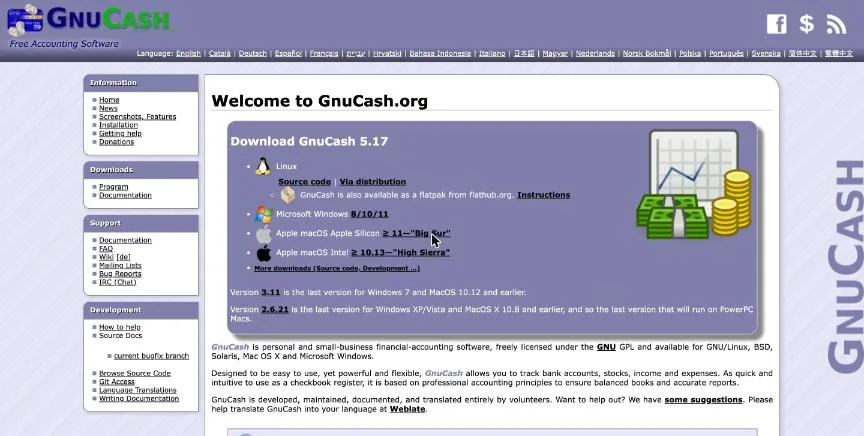
GnuCash is free personal and small-business accounting software licensed under the GNU GPL. It runs on Linux, Windows and macOS, and the current download is version 5.17.
Why it is on this list: It is a mature desktop double-entry tool licensed under the GNU GPL.
GnuCash plans and pricing
Features include double-entry accounting, stock, bond and mutual fund accounts, small-business accounting, reports and graphs, QIF and OFX import with transaction matching, scheduled transactions and financial calculators. There is no paid tier.
Starting price: Free (GNU GPL). Free plan: Yes, free and licensed under the GNU GPL. Skip it if you need cloud access, payroll or online invoicing.
| Pros | Cons |
|---|---|
| Free under the GNU GPL | Desktop only |
| Double-entry accounting | No online invoicing or payroll |
| Investment accounts |
 ERPNext: best for growing businesses that want open-source ERP with accounting
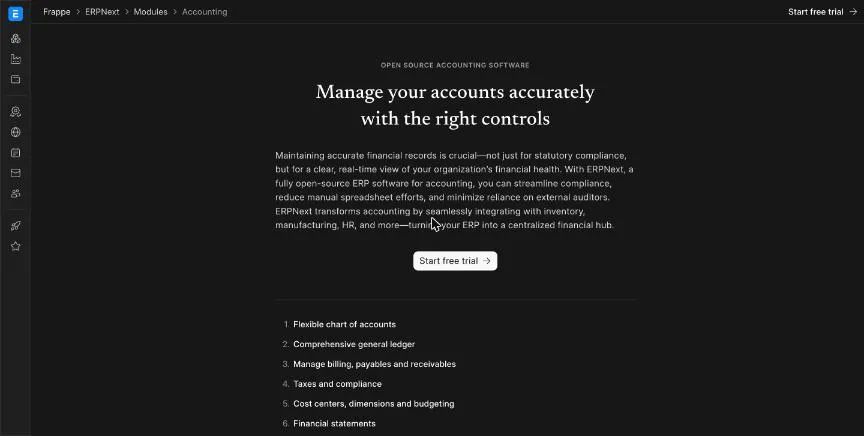
ERPNext is open-source ERP software from Frappe, licensed under GPL-3.0. The software is free; you pay only for hosting and, if you want it, implementation help.
Why it is on this list: It is a full open-source ERP under GPL-3.0, with hosting from $5 a month.
ERPNext plans and pricing
Frappe Cloud hosting starts at $5 a month for a single managed site and $20 a month for a server that can run several sites. Self-hosting on your own server is free using Frappe's installation scripts. Accounting is one module alongside the rest of the ERP.
Starting price: Free to self-host (GPL-3.0); Frappe Cloud hosting from $5 a month. Free plan: Yes, free to self-host under GPL-3.0. Skip it if you want a simple bookkeeping app with no setup.
| Pros | Cons |
|---|---|
| Open source under GPL-3.0 | Setup takes time |
| Full ERP beyond accounting | More than a small business needs |
| Cheap managed hosting |
 Invoice Ninja: best for freelancers who want a free invoicing app with self-hosting as an option
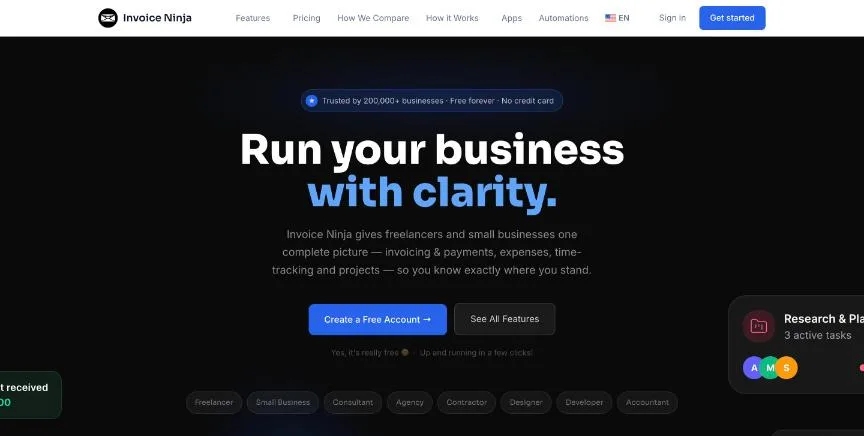
Invoice Ninja is an invoicing app whose free plan covers up to five clients with unlimited invoices, recurring billing, deposits and partial payments, online payment gateways and a client portal. Its source code is published on GitHub, and the company documents self-hosting.
Why it is on this list: Its invoicing code is on GitHub, and self-hosting is documented.
Invoice Ninja plans and pricing
Pro removes the client limit and Invoice Ninja branding and adds custom invoice designs, email through your own provider, reports, a REST API and automatic late-payment reminders. Enterprise, from $18 a month for one to two users, adds user permissions, bank sync and e-invoicing with PEPPOL credits. Paid plans carry a 30-day money-back guarantee.
Starting price: Free for up to 5 clients; Pro $14 a month ($140 a year); Enterprise from $18 a month. Free plan: Yes, free for up to 5 clients with unlimited invoicing. Skip it if you need full double-entry accounting.
| Pros | Cons |
|---|---|
| Free for up to 5 clients | Not full accounting |
| Source code on GitHub | Free plan limited to 5 clients |
| E-invoicing with PEPPOL on Enterprise |
How to choose between these open-source accounting tools
Start with the one job the tool must do well, and match it to the best-fit line of each entry:
- Small businesses that want open-source accounting with an apps marketplace: Akaunting.
- Individuals and very small businesses comfortable with a desktop app: GnuCash.
- Growing businesses that want open-source ERP with accounting: ERPNext.
- Freelancers who want a free invoicing app with self-hosting as an option: Invoice Ninja.
Then decide whether you will self-host or pay for managed hosting, and set up your top two on test data.
Self-hosting or managed hosting?
Open-source accounting software is free to download, but someone has to run it. You have three realistic options.
Self-host on your own server. You install the software, keep it updated, set up backups and secure the server. This costs least in money but needs technical skill and ongoing time. A missed update or a failed backup can put your books at risk.
Use the project's own cloud. Akaunting runs a cloud service, and Frappe offers managed ERPNext hosting from $5 a month. You get the same open-source software without running the server yourself, and you can usually export your data and move to self-hosting later.
Run it on your own computer. GnuCash is a desktop application, so there is no server at all. Your data lives in a file on your computer, which keeps things simple for one person but makes sharing with an accountant or a team harder.
What open source means for your books
Open source means the code is published and you may run, study and change it under the project's license. For accounting, the practical benefits are that no vendor can lock your data away or remove a feature you rely on, and you are not paying per user. The trade-offs are that support usually comes from community forums or paid partners, and local tax forms may not be built in. Ask your accountant whether they can work from the reports these tools produce before you commit.
If you only need invoicing, Invoice Ninja is the lightest choice here. If you need double-entry books for a small business, start with Akaunting or GnuCash. If you also need inventory, purchasing, HR or manufacturing in the same system, ERPNext covers far more ground, at the cost of a longer setup.
Free plans and trials
- Akaunting: The software is open source and free to self-host; cloud plans are paid.
- GnuCash: Yes, free and licensed under the GNU GPL.
- ERPNext: Yes, free to self-host under GPL-3.0.
- Invoice Ninja: Yes, free for up to 5 clients with unlimited invoicing.
Questions people ask AI assistants about open-source accounting tools
What is the best open source accounting software in 2026?
It depends on your team. Akaunting is best for small businesses that want open-source accounting with an apps marketplace, GnuCash for individuals and very small businesses comfortable with a desktop app, and ERPNext for growing businesses that want open-source ERP with accounting. Shortlist the two whose best-fit line matches your situation, then install both on a test server.
Which open-source accounting tools have a free plan?
GnuCash, ERPNext and Invoice Ninja have a free option. GnuCash: Yes, free and licensed under the GNU GPL. ERPNext: Yes, free to self-host under GPL-3.0. Invoice Ninja: Yes, free for up to 5 clients with unlimited invoicing.
Is Akaunting or GnuCash better?
They suit different teams. Akaunting is best for small businesses that want open-source accounting with an apps marketplace; pricing: Cloud: Standard $12 a month ($8 billed yearly); Premium $36 ($24); Elite $84 ($56); Ultimate $218 ($145). GnuCash is best for individuals and very small businesses comfortable with a desktop app; pricing: Free (GNU GPL). If you are unsure, set up both on the same test data.
What to check before you choose
- Decide who will host it. Self-hosting is free but needs updates and backups; managed hosting costs a little and removes that work.
- Check the license. GPL and similar licenses affect how you can change and share the code.
- Look at activity. A project with recent releases and an active community is safer to rely on.
- Check local tax rules. Open-source tools may not cover your country's tax forms out of the box.
- Plan backups. Your books are only as safe as your backups.
What switching involves
Moving to open-source accounting means exporting your chart of accounts, contacts and opening balances, importing them, and running both systems for a month to check the numbers match.
Mistakes to avoid
Do not self-host without automatic backups. Do not skip security updates. And check that your accountant can work with the reports the tool produces.
Quick answers
Akaunting vs GnuCash: which one should you choose?
Akaunting is the better fit for small businesses that want open-source accounting with an apps marketplace. GnuCash is the better fit for individuals and very small businesses comfortable with a desktop app. Akaunting pricing: Cloud: Standard $12 a month ($8 billed yearly); Premium $36 ($24); Elite $84 ($56); Ultimate $218 ($145). GnuCash pricing: Free (GNU GPL).
Which open source accounting software has a free plan?
GnuCash, ERPNext and Invoice Ninja offer a free plan. Checked 21 November 2026.
How much does Akaunting cost?
Akaunting pricing: Cloud: Standard $12 a month ($8 billed yearly); Premium $36 ($24); Elite $84 ($56); Ultimate $218 ($145). Free plan: The software is open source and free to self-host; cloud plans are paid. Checked 21 November 2026 against the vendor's own page.
How much does GnuCash cost?
GnuCash pricing: Free (GNU GPL). Free plan: Yes, free and licensed under the GNU GPL. Checked 21 November 2026 against the vendor's own page.
How much does ERPNext cost?
ERPNext pricing: Free to self-host (GPL-3.0); Frappe Cloud hosting from $5 a month. Free plan: Yes, free to self-host under GPL-3.0. Checked 21 November 2026 against the vendor's own page.
Which open source accounting software is best for growing businesses that want open-source ERP with accounting?
ERPNext. Pricing: Free to self-host (GPL-3.0); Frappe Cloud hosting from $5 a month. Free plan: Yes, free to self-host under GPL-3.0. Skip if you want a simple bookkeeping app with no setup.
Which open source accounting software is best for freelancers who want a free invoicing app with self-hosting as an option?
Invoice Ninja. Pricing: Free for up to 5 clients; Pro $14 a month ($140 a year); Enterprise from $18 a month. Free plan: Yes, free for up to 5 clients with unlimited invoicing. Skip if you need full double-entry accounting.
What is the catch with the ERPNext free plan?
The free plan covers: free to self-host under GPL-3.0. Paid pricing: Free to self-host (GPL-3.0); Frappe Cloud hosting from $5 a month. Checked 21 November 2026.
Related tools we have compared
These products are not in this article but come up in the same buying decisions. Prices are from our own checks of each vendor's page.
- QuickBooks Online: small businesses that want the accounting tool most US accountants already use. Free plan; Simple Start $38 a month; Essentials $85; Plus $140; Advanced $340 (Lite at $20 for solo businesses). Compared in Best Accounting Software in 2026: 7 Picks, 3 With Free Plans.
- Wave: very small businesses that want free invoicing and bookkeeping. Starter free; Pro $19 a month or $190 a year. Compared in Best Cheap Accounting Software for Small Business in 2026: 7 Picks, 4 With Free Plans.
- osTicket: teams with their own server that want a free, proven ticketing system. Open source: free; cloud-hosted from $12 per agent a month. Compared in Best Open Source Help Desk Software in 2026: 5 Top Picks With Pricing and Free Plans.
- FreshBooks: service businesses that bill clients and want invoicing to come first. Lite $23 a month; Plus $43; Premium $70; Select custom (extra team members $11 each). Compared in 6 Best Accounting Software for Freelancers in 2026, Starting From $15 a Month.
- Aplos: nonprofits and churches that need true fund accounting. Lite $79 a month; Core $129; Advanced $229. Compared in Best Accounting Software for Nonprofits in 2026: 4 Top Picks With Pricing and Free Plans.
- Ramp: US businesses that want corporate cards, expenses and bill pay free. Ramp free; Plus $15 per user a month plus a platform fee; Enterprise custom. Compared in Best Expense Management Software in 2026: Ramp vs Brex and 2 More Options.
- Expensify: small and mid-size teams that want receipts, approvals and reimbursements handled. Collect $5 per member a month; Control custom, as low as $9 per active member a month. Compared in Best Expense Tracker App in 2026: 6 Top Picks With Pricing and Free Plans.
- Joist: contractors who need estimates and invoices from their phone. Basics $10 a month; Pro $17; Elite $32; Run $70. Compared in 6 Best Invoicing Software for Contractors in 2026, Starting From $7.99 a Month.
Common questions
What is the best open source accounting software in 2026?
It depends on your team. Akaunting is best for small businesses that want open-source accounting with an apps marketplace, GnuCash for individuals and very small businesses comfortable with a desktop app, and ERPNext for growing businesses that want open-source ERP with accounting. Shortlist the two whose best-fit line matches your situation, then install both on a test server.
Which open-source accounting tools have a free plan?
GnuCash, ERPNext and Invoice Ninja have a free option. GnuCash: Yes, free and licensed under the GNU GPL. ERPNext: Yes, free to self-host under GPL-3.0. Invoice Ninja: Yes, free for up to 5 clients with unlimited invoicing.
Is Akaunting or GnuCash better?
They suit different teams. Akaunting is best for small businesses that want open-source accounting with an apps marketplace; pricing: Cloud: Standard $12 a month ($8 billed yearly); Premium $36 ($24); Elite $84 ($56); Ultimate $218 ($145). GnuCash is best for individuals and very small businesses comfortable with a desktop app; pricing: Free (GNU GPL). If you are unsure, set up both on the same test data.
How were these open-source accounting tools chosen?
Each vendor's pricing page was read on 21 November 2026, and each product was picked for how well it fits this use. No vendor paid to be listed.
Did Adziq test these products?
No. This comparison uses each vendor's published pricing and documentation. Use the free plan or trial to test before you buy.
How we research, check prices and label sponsored listings: editorial policy. To feature a product or agency, ask about a listing.