The short answer
QuickBooks Online is best for small businesses that want the accounting tool most US accountants already use, Xero for small businesses that want unlimited users and a large app marketplace, and Zoho Books for small businesses that want a real free plan and low prices as they grow. 2 of the 5 have a free option.
Online sellers need their books to match payouts from Shopify, Amazon and payment processors after fees, refunds and taxes. Most use a general accounting tool plus a connector that turns each payout into a clean entry.
This page compares 5 ecommerce accounting tools on starting price, free plan and who each one suits. It also answers the questions people type into ChatGPT, Gemini and Perplexity, such as "what is the best accounting software for e commerce", "which ecommerce accounting tools are free" and "is QuickBooks Online or Xero better", using only figures read from the vendors' own pages.
Accounting Software for Ecommerce at a glance
| # | Pick | Best for | Starting price | Free plan |
|---|---|---|---|---|
| 1 | Small businesses that want the accounting tool most US accountants already use | Free plan; Simple Start $38 a month; Essentials $85; Plus $140; Advanced $340 (Lite at $20 for solo businesses) | Yes, a Free plan with 1 user, 2 invoices a month and 1 bank connection; 30-day trial of paid plans | |
| 2 | Small businesses that want unlimited users and a large app marketplace | Early $27 a month; Growing $59; Established $97 | No free plan; new US customers were offered 90% off for six months when we checked | |
| 3 | Small businesses that want a real free plan and low prices as they grow | Free under $50K revenue; Standard $20 a month ($15 billed yearly); Professional $50 ($40); Premium $70 ($60); Elite $150 ($120) | Yes, free for businesses under $50K revenue a year, with 1 user plus an accountant; 14-day trial | |
| 4 | Shopify and Amazon sellers who want clean payout entries in their books | From $29 a month for Shopify or Amazon (higher volumes cost more) | No free plan; free trial | |
| 5 | Online sellers with several sales channels and payment processors | Basic $65 a month ($52 billed yearly); Essential from $129 ($103); Pro from $299 ($240) | No free plan; 15-day trial with no card |
How we chose
Every price, plan limit and feature on this page was read from each vendor's own pricing page on 21 November 2026. We chose these 5 ecommerce accounting tools for how well they fit this use, not for who pays: no vendor paid to be listed, and the order is not a ranking by price. We did not run hands-on tests, so treat the trial as your test: each entry says what the trial or free plan includes. Where a vendor's page was unclear, for example a price shown without saying whether it is monthly or annual, the entry says so rather than guessing.
 QuickBooks Online: best for small businesses that want the accounting tool most US accountants already use
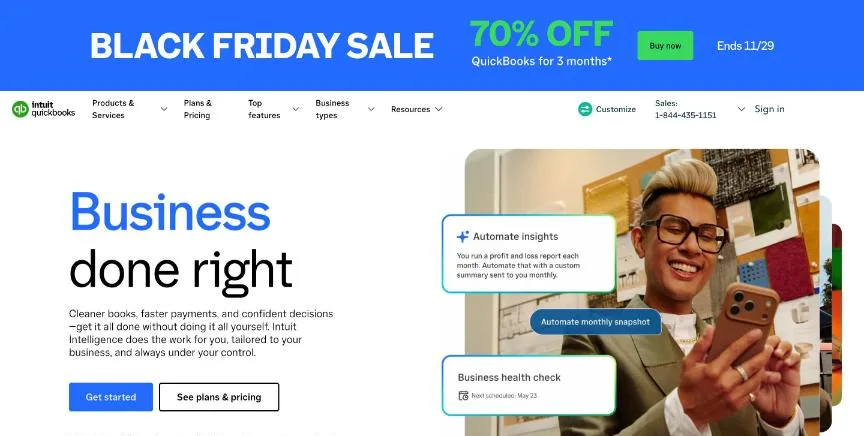
QuickBooks Online is Intuit's cloud accounting software. Its pricing page now opens with a Free plan that tracks income and expenses, sends two invoices a month, runs the top three reports and connects one bank account. For one-person businesses, Intuit also sells a Lite plan at $20 a month with unlimited receipts and mileage.
Why it is on this list: Plus adds inventory, and most ecommerce connectors support it.
QuickBooks Online plans and pricing
Simple Start (1 user) adds general reports, automated bookkeeping, invoicing with payments and free ACH bill pay. Essentials (3 users) adds enhanced reports, employee time on invoices and quarterly tax estimates. Plus (5 users) adds automatic reconciliation, budgets, project profitability, inventory and up to 40 classes and locations. Advanced (25 users) adds custom permissions, workflow automation, Excel sync and 1099 e-filing with approvals. At the time we checked, the page offered 70% off for the first three months.
Starting price: Free plan; Simple Start $38 a month; Essentials $85; Plus $140; Advanced $340 (Lite at $20 for solo businesses). Free plan: Yes, a Free plan with 1 user, 2 invoices a month and 1 bank connection; 30-day trial of paid plans. Skip it if you want a low price after the introductory discount ends.
| Pros | Cons |
|---|---|
| Free plan for very small businesses | Regular prices are high after the introductory discount |
| Most US accountants already know it | Users are capped on each plan |
| Plus adds inventory and project profitability |
 Xero: best for small businesses that want unlimited users and a large app marketplace
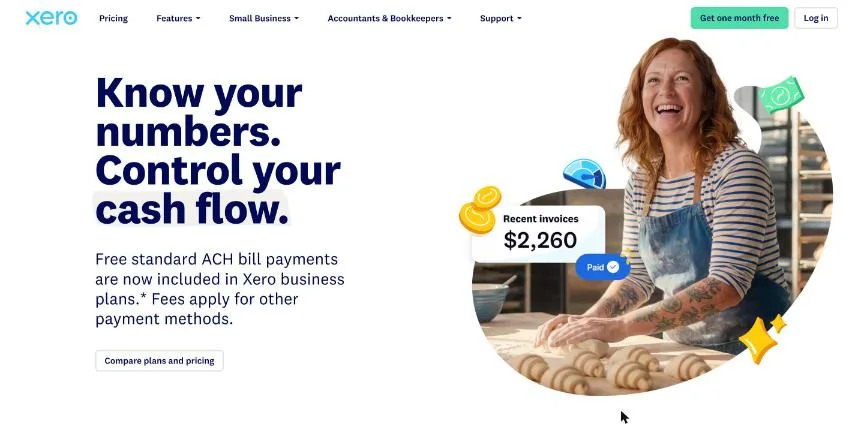
Xero is cloud accounting software used widely by small businesses and their accountants. The Early plan covers quotes and up to 20 invoices a month, five bills, bank reconciliation, sales tax, W-9 and 1099 management and income and expense tracking.
Why it is on this list: It works with A2X and Synder and has inventory add-ons.
Xero plans and pricing
Growing removes the invoice and bill limits and adds custom dashboards, three budgets and auto-reconciliation. Established adds multiple currencies, project time and cost tracking, employee expense and mileage claims, 180-day cash flow forecasts and international bill payments. Payroll comes through Gusto at $36 a month plus $6 per person. Standard domestic ACH bill payments are free on all plans.
Starting price: Early $27 a month; Growing $59; Established $97. Free plan: No free plan; new US customers were offered 90% off for six months when we checked. Skip it if you send more than 20 invoices a month but want the cheapest plan.
| Pros | Cons |
|---|---|
| Unlimited users on every plan | Early plan caps invoices at 20 a month |
| Payroll through Gusto | Expense claims and projects need Established |
| Free standard ACH bill payments |
 Zoho Books: best for small businesses that want a real free plan and low prices as they grow
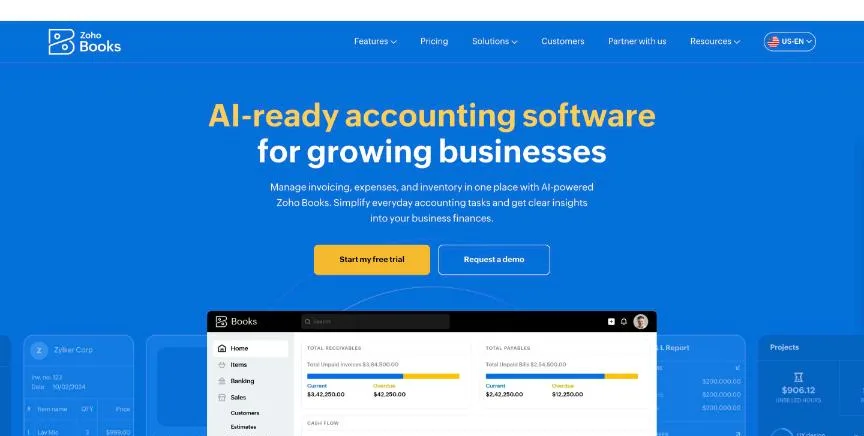
Zoho Books is Zoho's accounting app. The free plan, for businesses with revenue under $50K a year, covers invoices, quotes, expenses, journals, bank reconciliation, 1099 tracking and filing and more than 50 reports, with up to 1,000 invoices and 1,000 expenses a year.
Why it is on this list: Elite connects Etsy, eBay, Amazon and Shopify directly.
Zoho Books plans and pricing
Standard (3 users) adds progress invoicing, sales tax tracking, 1099 e-filing, bank feeds, custom reports and API access. Professional (5 users) adds purchase and sales orders, multiple currencies, project profitability, inventory tracking and approvals. Premium (10 users) adds budgets, fixed assets, cash flow forecasting and a vendor portal. Elite adds warehouses, serial and batch tracking and Etsy, eBay, Amazon and Shopify connections. Prices are per organization.
Starting price: Free under $50K revenue; Standard $20 a month ($15 billed yearly); Professional $50 ($40); Premium $70 ($60); Elite $150 ($120). Free plan: Yes, free for businesses under $50K revenue a year, with 1 user plus an accountant; 14-day trial. Skip it if your revenue is over $50K and you want everything in one low tier.
| Pros | Cons |
|---|---|
| Free plan for businesses under $50K revenue | Free plan ends once revenue passes $50K |
| Low yearly prices | User counts are capped per plan |
| Inventory and multi-currency on Professional |
 A2X: best for shopify and Amazon sellers who want clean payout entries in their books
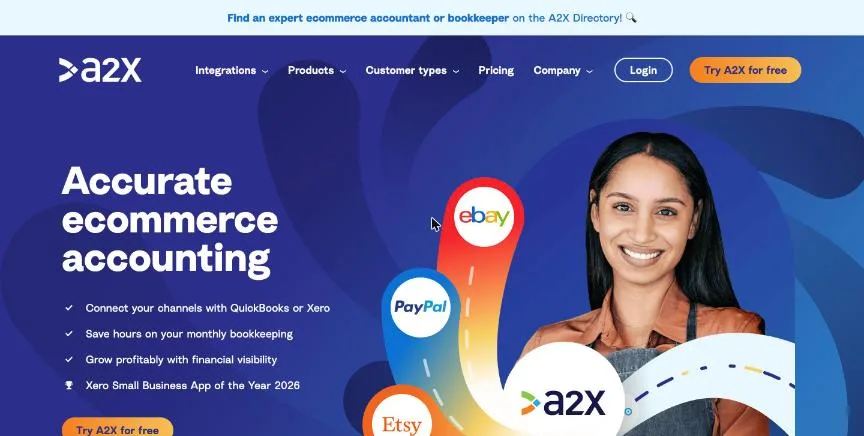
A2X turns Shopify payouts and Amazon settlements into summarised journal entries in QuickBooks Online, Xero or NetSuite, so your books match what lands in the bank.
Why it is on this list: It turns Shopify payouts and Amazon settlements into clean journal entries.
A2X plans and pricing
Shopify and Amazon each start at $29 a month, with prices rising by order volume on separate pricing pages.
Starting price: From $29 a month for Shopify or Amazon (higher volumes cost more). Free plan: No free plan; free trial. Skip it if you do not use QuickBooks Online, Xero or NetSuite.
| Pros | Cons |
|---|---|
| Clean Shopify and Amazon entries | Not accounting software itself |
| Works with QuickBooks, Xero and NetSuite | Price rises with order volume |
| Free trial |
 Synder: best for online sellers with several sales channels and payment processors
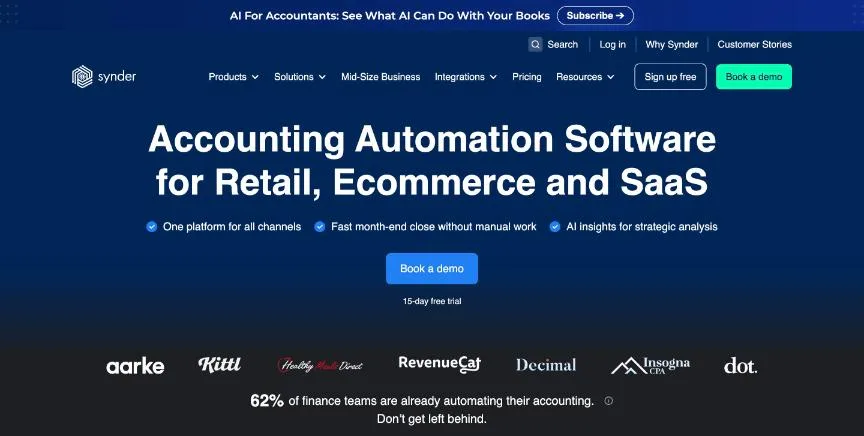
Synder syncs sales and payment data from e-commerce platforms and payment processors into accounting software. Basic includes 500 synced transactions a month, two integrations, daily imports and QuickBooks Online, Xero and Puzzle.
Why it is on this list: It syncs several sales channels and payment processors into your books.
Synder plans and pricing
Essential raises the limit to 1,000 transactions with unlimited integrations and hourly imports. Pro raises it to 10,000 and adds NetSuite, Intuit Enterprise Suite and Sage Intacct. Purchases are non-refundable, so use the trial first.
Starting price: Basic $65 a month ($52 billed yearly); Essential from $129 ($103); Pro from $299 ($240). Free plan: No free plan; 15-day trial with no card. Skip it if you have a low order volume and one channel.
| Pros | Cons |
|---|---|
| Syncs many channels and processors | Starts at $65 a month |
| Hourly imports on Essential | Purchases are non-refundable |
| 15-day trial with no card |
How to choose between these ecommerce accounting tools
Start with the one job the tool must do well, and match it to the best-fit line of each entry:
- Small businesses that want the accounting tool most US accountants already use: QuickBooks Online.
- Small businesses that want unlimited users and a large app marketplace: Xero.
- Small businesses that want a real free plan and low prices as they grow: Zoho Books.
- Shopify and Amazon sellers who want clean payout entries in their books: A2X.
- Online sellers with several sales channels and payment processors: Synder.
Then price the plan you would really use after any introductory discount ends, including payroll, payment fees and extra users, and run a month of real transactions through the trial of your top two.
Free plans and trials
- QuickBooks Online: Yes, a Free plan with 1 user, 2 invoices a month and 1 bank connection; 30-day trial of paid plans.
- Xero: No free plan; new US customers were offered 90% off for six months when we checked.
- Zoho Books: Yes, free for businesses under $50K revenue a year, with 1 user plus an accountant; 14-day trial.
- A2X: No free plan; free trial.
- Synder: No free plan; 15-day trial with no card.
Questions people ask AI assistants about ecommerce accounting tools
What is the best accounting software for e commerce in 2026?
It depends on your team. QuickBooks Online is best for small businesses that want the accounting tool most US accountants already use, Xero for small businesses that want unlimited users and a large app marketplace, and Zoho Books for small businesses that want a real free plan and low prices as they grow. Shortlist the two whose best-fit line matches your situation, then run a month of real transactions through both trials.
Which ecommerce accounting tools have a free plan?
QuickBooks Online and Zoho Books have a free option. QuickBooks Online: Yes, a Free plan with 1 user, 2 invoices a month and 1 bank connection. Zoho Books: Yes, free for businesses under $50K revenue a year, with 1 user plus an accountant.
Is QuickBooks Online or Xero better?
They suit different teams. QuickBooks Online is best for small businesses that want the accounting tool most US accountants already use; pricing: Free plan; Simple Start $38 a month; Essentials $85; Plus $140; Advanced $340 (Lite at $20 for solo businesses). Xero is best for small businesses that want unlimited users and a large app marketplace; pricing: Early $27 a month; Growing $59; Established $97. If you are unsure, run the same month of transactions through both.
What to check before you choose
- Look past the introductory price. Several accounting tools show 50% to 90% off for the first months. Compare the regular monthly price, because that is what you will pay for years.
- Ask your accountant first. Most accountants work fastest in one or two tools. Using theirs can lower your bookkeeping and tax prep bill.
- Check users, clients and invoice limits. Entry plans often cap users, billable clients or invoices a month. Count what you need today and next year.
- Add up payment and payroll fees. Card fees, ACH fees and payroll add-ons often cost more than the subscription. Price them at your real volume.
- Test bank feeds with your bank. Automatic bank imports save the most time, but not every bank connects to every tool. Connect yours during the trial.
What switching involves
Switching accounting software is easiest at the start of a financial year. Export your chart of accounts, customers, vendors, open invoices and bills, and opening balances from the old tool, import them into the new one, and keep read-only access to the old books for at least as long as tax rules require you to keep records. Ask your accountant to check the opening balances before you start using the new tool.
Mistakes to avoid
Do not choose on the introductory price: many plans cost several times more once the discount ends. Do not skip asking your accountant which tool they support, because that saves fees at tax time. And do not switch in the middle of a tax year if you can wait for a clean start.
Quick answers
QuickBooks Online vs Xero: which one should you choose?
QuickBooks Online is the better fit for small businesses that want the accounting tool most US accountants already use. Xero is the better fit for small businesses that want unlimited users and a large app marketplace. QuickBooks Online pricing: Free plan; Simple Start $38 a month; Essentials $85; Plus $140; Advanced $340 (Lite at $20 for solo businesses). Xero pricing: Early $27 a month; Growing $59; Established $97.
Which accounting software for e commerce has a free plan?
QuickBooks Online and Zoho Books offer a free plan. A2X and Synder offer a free trial instead. Checked 21 November 2026.
How much does QuickBooks Online cost?
QuickBooks Online pricing: Free plan; Simple Start $38 a month; Essentials $85; Plus $140; Advanced $340 (Lite at $20 for solo businesses). Free plan: Yes, a Free plan with 1 user, 2 invoices a month and 1 bank connection; 30-day trial of paid plans. Checked 21 November 2026 against the vendor's own page.
How much does Xero cost?
Xero pricing: Early $27 a month; Growing $59; Established $97. Free plan: No free plan; new US customers were offered 90% off for six months when we checked. Checked 21 November 2026 against the vendor's own page.
How much does Zoho Books cost?
Zoho Books pricing: Free under $50K revenue; Standard $20 a month ($15 billed yearly); Professional $50 ($40); Premium $70 ($60); Elite $150 ($120). Free plan: Yes, free for businesses under $50K revenue a year, with 1 user plus an accountant; 14-day trial. Checked 21 November 2026 against the vendor's own page.
Which accounting software for e commerce is best for small businesses that want a real free plan and low prices as they grow?
Zoho Books. Pricing: Free under $50K revenue; Standard $20 a month ($15 billed yearly); Professional $50 ($40); Premium $70 ($60); Elite $150 ($120). Free plan: Yes, free for businesses under $50K revenue a year, with 1 user plus an accountant; 14-day trial. Skip if your revenue is over $50K and you want everything in one low tier.
Which accounting software for e commerce is best for shopify and Amazon sellers who want clean payout entries in their books?
A2X. Pricing: From $29 a month for Shopify or Amazon (higher volumes cost more). Free plan: No free plan; free trial. Skip if you do not use QuickBooks Online, Xero or NetSuite.
Which accounting software for e commerce is best for online sellers with several sales channels and payment processors?
Synder. Pricing: Basic $65 a month ($52 billed yearly); Essential from $129 ($103); Pro from $299 ($240). Free plan: No free plan; 15-day trial with no card. Skip if you have a low order volume and one channel.
What is the catch with the QuickBooks Online free plan?
The free plan covers: a Free plan with 1 user, 2 invoices a month and 1 bank connection; 30-day trial of paid plans. Paid pricing: Free plan; Simple Start $38 a month; Essentials $85; Plus $140; Advanced $340 (Lite at $20 for solo businesses). Checked 21 November 2026.
Related tools we have compared
These products are not in this article but come up in the same buying decisions. Prices are from our own checks of each vendor's page.
- FreshBooks: service businesses that bill clients and want invoicing to come first. Lite $23 a month; Plus $43; Premium $70; Select custom (extra team members $11 each). Compared in 6 Best Accounting Software for Freelancers in 2026, Starting From $15 a Month.
- Aplos: nonprofits and churches that need true fund accounting. Lite $79 a month; Core $129; Advanced $229. Compared in Best Accounting Software for Nonprofits in 2026: 4 Top Picks With Pricing and Free Plans.
- Wave: very small businesses that want free invoicing and bookkeeping. Starter free; Pro $19 a month or $190 a year. Compared in Best Cheap Accounting Software for Small Business in 2026: 7 Picks, 4 With Free Plans.
- Klaviyo: ecommerce stores that want email and SMS in one place. $20 per month, Email plan (500 active profiles, monthly billing). Compared in Best SMS Marketing Platforms ROI E Commerce in 2026: 7 Picks, 3 With Free Plans.
- Akaunting: small businesses that want open-source accounting with an apps marketplace. Cloud: Standard $12 a month ($8 billed yearly); Premium $36 ($24); Elite $84 ($56); Ultimate $218 ($145). Compared in Best Open Source Accounting Software in 2026: 4 Picks for Self-Hosting and Cloud.
- Expensify: small and mid-size teams that want receipts, approvals and reimbursements handled. Collect $5 per member a month; Control custom, as low as $9 per active member a month. Compared in Best Expense Tracker App in 2026: 6 Top Picks With Pricing and Free Plans.
- Joist: contractors who need estimates and invoices from their phone. Basics $10 a month; Pro $17; Elite $32; Run $70. Compared in 6 Best Invoicing Software for Contractors in 2026, Starting From $7.99 a Month.
- Shoeboxed: owners with paper receipts who want them scanned for them. Starter $9 a month ($97 a year); Pro $29 ($297 a year); Plus $79 ($797 a year). Compared in 6 Best Receipt Scanner Software in 2026, Starting From $4 a Month.
Common questions
What is the best accounting software for e commerce in 2026?
It depends on your team. QuickBooks Online is best for small businesses that want the accounting tool most US accountants already use, Xero for small businesses that want unlimited users and a large app marketplace, and Zoho Books for small businesses that want a real free plan and low prices as they grow. Shortlist the two whose best-fit line matches your situation, then run a month of real transactions through both trials.
Which ecommerce accounting tools have a free plan?
QuickBooks Online and Zoho Books have a free option. QuickBooks Online: Yes, a Free plan with 1 user, 2 invoices a month and 1 bank connection. Zoho Books: Yes, free for businesses under $50K revenue a year, with 1 user plus an accountant.
Is QuickBooks Online or Xero better?
They suit different teams. QuickBooks Online is best for small businesses that want the accounting tool most US accountants already use; pricing: Free plan; Simple Start $38 a month; Essentials $85; Plus $140; Advanced $340 (Lite at $20 for solo businesses). Xero is best for small businesses that want unlimited users and a large app marketplace; pricing: Early $27 a month; Growing $59; Established $97. If you are unsure, run the same month of transactions through both.
How were these ecommerce accounting tools chosen?
Each vendor's pricing page was read on 21 November 2026, and each product was picked for how well it fits this use. No vendor paid to be listed.
Did Adziq test these products?
No. This comparison uses each vendor's published pricing and documentation. Use the free plan or trial to test before you buy.
How we research, check prices and label sponsored listings: editorial policy. To feature a product or agency, ask about a listing.