
The short answer
Manufacturing content is two jobs, and no single platform does both well. Paligo, from $15,000 a year, is the pick for technical manuals and structured documentation. Storyblok, from $99 a month, is the pick for product sites and marketing pages. WordPress costs nothing for the software and suits a tight budget.
Key takeaways
- Paligo CCMS Business starts at $15,000 a year and includes 2 authors and 2 languages.
- Storyblok Growth costs $99 a month, or $90.75 a month billed annually, with a free Starter plan below it.
- WordPress software is free; you pay for hosting, maintenance and security, not a licence.
- MadCap Flare starts at $3,150 a year per author; Adobe Experience Manager and Bynder publish no prices and are sold by quote.
- HubSpot Content Hub Starter is listed from $20 a seat a month, with free tools below the paid plans.
How we chose
Manufacturing content is two different jobs: marketing content that wins orders, and technical content — manuals, spec sheets and service guides — that the law and your customers require. A great marketing CMS will mangle a 400-page manual, and a documentation system will bore your prospects. This list covers both jobs and says plainly which job each platform does. Prices come from each vendor's own pricing page, checked on 14 November 2026. No hands-on testing was done, so this post compares published pricing and documentation, checked on 14 November 2026. Two of the seven vendors publish no price, and that is noted wherever it applies.
1. MadCap Software: best for technical manuals at product scale
MadCap Software is the name technical writing teams in manufacturing reach for first. Its Flare tool authors manuals and help systems, and its IXIA CCMS manages content as reusable components under the DITA standard, so one specification, written once, assembles into hundreds of product publications. Flare starts at $3,150 a year per author. Flare Online is licensed per user and billed annually, with a 12-month commitment, and the cloud plans add review seats, storage and translation workflows by tier.
MadCap fits a manufacturer with a large catalogue and a dedicated documentation team. Component reuse is the point: the same warning, the same torque figure, the same procedure, repeated across every variant, in every language, always correct. The weakness is the learning curve. DITA structured authoring is a real discipline, and IXIA CCMS is quoted rather than priced on the page.
Skip MadCap Software if you have three products and no dedicated technical writers. Paligo gives you the same idea with a gentler start, and WordPress covers the public site.
2. Paligo: best for cloud-based structured documentation
Paligo is a cloud component content management system. Writers work in a browser editor while the system keeps content structured underneath, so topics can be reused across manuals, filtered by product variant, translated as components, and published to print and web from one source. CCMS Business starts at $15,000 a year, with 2 authors and 2 languages included, and Enterprise is custom priced with 8 authors and unlimited languages. Two add-ons are priced separately: Nexus Portal from $5,000 a year for hosted delivery, and Nexus Answers from $6,000 a year for AI answers grounded in published content.
Paligo fits a mid-sized manufacturer whose manuals have outgrown folders of Word files. It is the gentlest route into structured documentation, with a free trial of the CCMS available. The weakness is scope. Paligo does documentation, not campaigns. A manufacturer pairs it with a marketing platform and lets each do its own job.
Skip Paligo if your budget is under $15,000 a year for documentation. That floor is the whole Business plan, and there is no cheaper tier below it.
3. Adobe Experience Manager: best for enterprise marketing and product sites
Adobe Experience Manager is the enterprise marketing platform: the website, the product catalogue front end, the campaign pages and the asset library behind them, governed centrally and localised across every market. Large manufacturers with several brands and regions use it to keep thousands of product pages consistent and current, and its asset management half alone justifies the evaluation for image and video heavy catalogues.
Adobe Experience Manager fits a global manufacturer whose marketing estate is itself a product. The weakness is the commitment: Adobe publishes no price, licences are enterprise-scale, implementation needs specialist partners, and it needs dedicated administrators. It also stops where documentation starts: manuals belong in MadCap or Paligo.
Skip Adobe Experience Manager if you have no implementation partner or dedicated administrators. Storyblok or HubSpot will run the same marketing site with far less overhead.
4. HubSpot Content Hub: best for mid-market marketing tied to a CRM
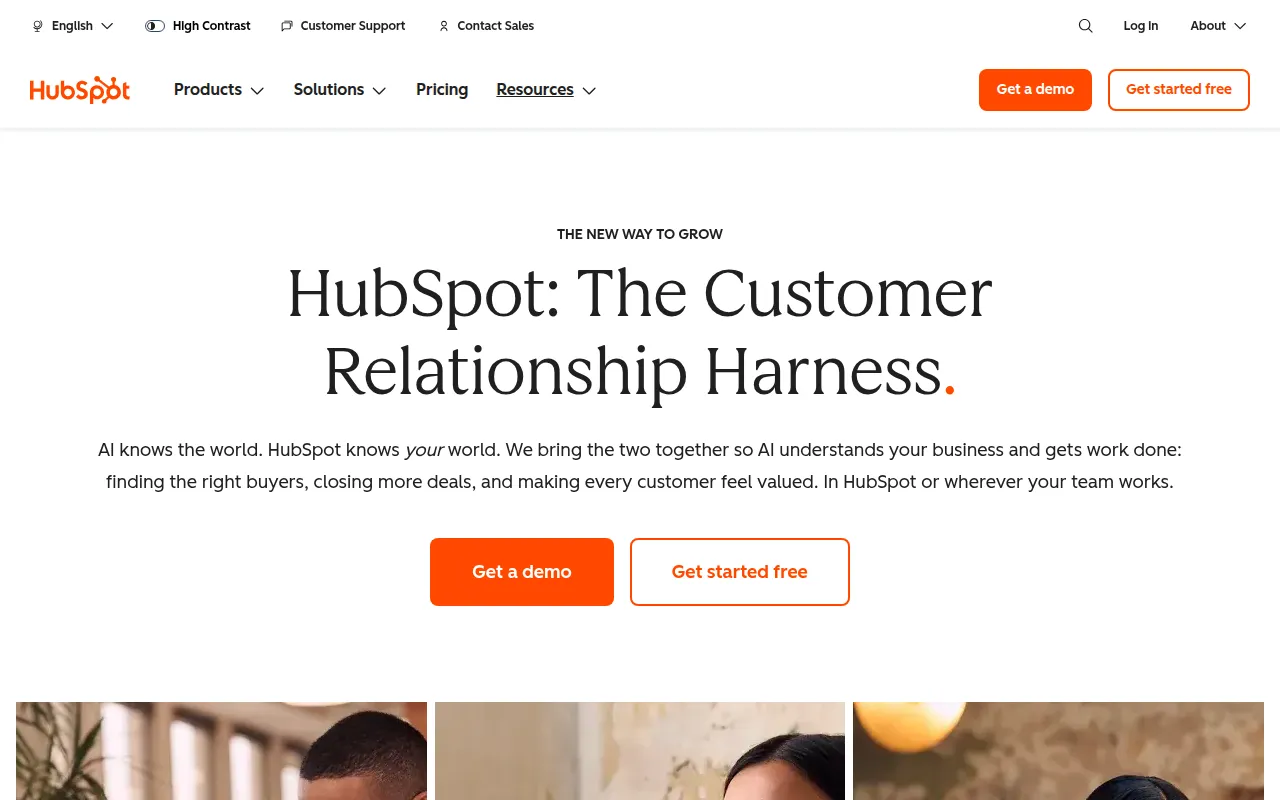
HubSpot Content Hub runs the website, the blog, the landing pages for trade shows and webinars, and the resource library of spec sheets and case studies, and every download lands in the CRM where sales can see it. For a company selling through quotes and relationships, that connection is the product. Guides checked in October 2026 list Content Hub Starter from $20 a seat a month, with free tools below the paid plans — confirm the current seat price on HubSpot's pricing page before budgeting, as HubSpot reprices its hubs often.
HubSpot fits the mid-market manufacturer whose marketing team is three people and a CRM. It is far easier to run than an enterprise suite, and it carries built-in SEO guidance, forms and email in the same system. The weakness is dependence: its value depends on adopting HubSpot's CRM, design flexibility is good rather than limitless, and it has no technical documentation capability.
Skip HubSpot Content Hub if you do not want your website tied to HubSpot's CRM. WordPress gives you the same site with no vendor lock-in, and Storyblok gives you the same pages with more design freedom.
5. WordPress: best for affordable websites and resource centres
WordPress is free, open-source software, and it runs a large share of manufacturing websites for a simple reason: it is free, familiar, and good enough for the marketing job at most companies. A competent agency can build a product catalogue, a dealer locator, a careers section and a resource centre of PDFs and videos on it, and hand over a site the marketing team can update without help. You pay for hosting, maintenance and security, not a licence.
WordPress fits almost any manufacturer as the public site, especially one with a tight budget. The plugin ecosystem covers catalogues, dealer locators and document libraries, and any agency anywhere can build and maintain it. The weakness is ownership: you own security, updates and backups, and plugin quality varies.
Skip WordPress if you need structured documentation or component reuse. That is Paligo's job, and WordPress is the wrong tool for it.
6. Storyblok: best for product sites with visual editing
Storyblok is a headless CMS with a visual editor. Engineers build fast product pages, configurators and dealer portals once, while marketers update ranges, launch products and localise pages without a ticket. Component-based content matches how product families actually work: shared blocks with per-model variations. The Starter plan is free, Growth costs $99 a month or $90.75 a month billed annually, and Growth Plus is $349 a month. Every new space starts with a 45-day free trial of Growth Plus.
Storyblok fits the manufacturer whose product site has become a development bottleneck. The free Starter plan lets a team prove the idea before paying. The weakness is that front-end development is required up front, and its localisation is lighter than the component systems above. It will not produce your service manuals.
Skip Storyblok if you need print manuals or DITA workflows. Paligo and MadCap are built for that job; Storyblok is not.
7. Bynder: best for brand and product asset management
Bynder is a digital asset management platform. Behind every manufacturer's content sits an asset problem: ten thousand product images, renders, videos, logos and translations of each, scattered across drives and agencies. Bynder centralises them with metadata, rights, versions and approval workflows, and a portal where dealers and partners download the approved files themselves. Pricing is by quote, and the pricing page carries no figures.
Bynder fits a manufacturer whose brand leaks through outdated assets in the field. It is deliberately one layer of the stack: it makes sure the image on a page is the current, approved, correctly sized one. The weakness is that it is asset management only, and the taxonomy setup takes real work at the start.
Skip Bynder if you need pages or documents, not just asset storage. A CMS such as Storyblok or WordPress is the missing layer, and Bynder plugs into either.
What a manufacturer pays in year one
| Platform | Year-one cost | What it covers |
|---|---|---|
| WordPress | $0 for software, plus hosting | Marketing site, catalogue, resource centre |
| Storyblok Growth | $1,188 a year ($99 a month) | Product site, visual editing, 5 seats |
| HubSpot Content Hub Starter | From $20 a seat a month | Website, blog and CRM connection |
| Paligo CCMS Business | $15,000 a year | Structured documentation, 2 authors, 2 languages |
| MadCap Software | Flare from $3,150 a year per author | Flare authoring plus IXIA CCMS |
| Adobe Experience Manager | Pricing on request | Enterprise sites, assets and localisation |
| Bynder | Pricing on request | Asset library, brand control, dealer portal |
A realistic stack for a mid-sized manufacturer is WordPress for the public site plus Paligo for manuals, at $15,000 a year plus hosting — far less than Adobe Experience Manager, and each tool doing the job it was built for. Add Bynder when dealer asset chaos, not page building, is the problem.
How to match the platform to your content type
| Your content problem | Pick |
|---|---|
| Manuals for hundreds of product variants | MadCap Software or Paligo |
| Manuals, but your team is new to structured content | Paligo, from $15,000 a year |
| Global marketing sites across brands and regions | Adobe Experience Manager, by quote |
| Marketing content tied to quotes and pipeline | HubSpot Content Hub, from $20 a seat a month |
| A solid public site on a tight budget | WordPress, free software |
| Product pages marketers can update without developers | Storyblok, from $99 a month |
| Dealers using outdated brochures and images | Bynder, by quote |
Decide the content type first and the platform second. If the content is a manual, buy a documentation system. If it is a product page, buy a CMS. If it is an asset, buy a DAM. Buying one platform for all three jobs is how manufacturers end up with a tool that does none of them well.
Manufacturing content terms worth knowing
- DITA: Darwin Information Typing Architecture, a standard for structuring technical content into reusable topics.
- CCMS: component content management system; software that stores content as reusable components rather than whole documents.
- Single sourcing: writing a piece of content once and publishing it into many outputs — manuals, web help, PDFs — from the same source.
- Headless CMS: a content system that stores content and delivers it through an API, while a separate front end renders the pages.
- DAM: digital asset management; a library for images, video and brand files, with metadata, rights and versions.
Mistakes to avoid with manufacturing content platforms
- Buying a marketing CMS to write manuals. A 400-page manual with variant filtering and component translation needs a CCMS. A marketing CMS will force the work into pages and cost more in the end.
- Buying a CCMS to run a marketing site. Paligo and MadCap publish documentation, not campaigns. Your prospects will not be won over by a help centre.
- Ignoring translation costs. Translation is where costs hide. Component reuse cuts translation bills because a changed warning is translated once, not once per manual. Ask each vendor how reuse and translation memory work before you sign.
- Underestimating the taxonomy. Bynder and the CCMS tools all need a metadata structure designed up front. A library with no taxonomy is a shared drive with a login screen.
- Forgetting the dealers. If fifty dealers email three-year-old brochures, the fix is a governed asset portal, not a new website.
To compare the marketing CMS options further, see the best platform for content for SaaS and the best website content writing service. The content repurposing tools post shows how to reuse what you already have, and Adziq's content services cover content planning and production for teams that want it done for them.
Platform for Content for Manufacturing at a glance
| Pick | Best for | Starting price | Free plan |
|---|---|---|---|
| MadCap Software | Technical manuals at product scale | Flare from $3,150 a year per author | No |
| Paligo | Cloud-based structured documentation | From $15,000 a year (CCMS Business) | No, free trial |
| Adobe Experience Manager | Enterprise marketing and product sites | Pricing on request | No |
| HubSpot Content Hub | Mid-market marketing tied to a CRM | From $20 a seat a month (Starter) | Yes, free tools |
| WordPress | Affordable websites and resource centres | Free (software); hosting and maintenance extra | Yes |
| Storyblok | Product sites with visual editing | From $99 a month (Growth); free Starter plan | Yes, Starter plan |
| Bynder | Brand and product asset management | Pricing on request | No |
Common questions
What is the best content platform for a manufacturing company?
It depends on the content. Paligo is the pick for technical manuals and documentation, from $15,000 a year. Storyblok is the pick for product sites and marketing pages, from $99 a month. Most manufacturers end up with one of each, not one platform for both jobs.
How much does Paligo cost?
Paligo CCMS Business starts at $15,000 a year, with 2 authors and 2 languages included. Enterprise is custom priced. Its Nexus Portal add-on starts at $5,000 a year and Nexus Answers at $6,000 a year.
Is WordPress good for manufacturing websites?
Yes, for the marketing site. WordPress is free software, any agency can build and maintain it, and plugins cover product catalogues, dealer locators and document libraries. It is not a documentation system, so pair it with Paligo or MadCap for manuals.
What is structured content, and why does it matter in manufacturing?
Structured content breaks documents into reusable components, such as a warning or a torque figure, written once and assembled into many publications. Change the component once and every manual, language and variant updates. That is what Paligo and MadCap sell.
Does HubSpot Content Hub work for manufacturers?
Yes, for marketing content. It runs the website, blog, landing pages and resource library, and every download lands in the CRM where sales can see it. It does not handle technical documentation, and its value depends on adopting HubSpot's CRM.
Sources
- MadCap Software pricing
- Paligo pricing
- Adobe Experience Manager
- HubSpot Marketing Hub pricing
- WordPress
- Storyblok pricing
- Bynder pricing
Adziq sells marketing services and does not accept payment for placement in its articles. See our editorial policy.