
The short answer
Blip Billboards suits a small budget, because you pay per 8-second display from $0.01 with no minimum spend and no contract. Vistar Media suits programmatic campaigns across many networks, AdQuick suits buyers wanting programmatic and direct inventory in one place, and Clear Channel Outdoor suits direct buys on premium screens.
Key takeaways
- Blip is the only pick with a published price: pay per 8-second display from $0.01, with no minimum spend.
- Vistar Media, Place Exchange, Broadsign and AdQuick are programmatic platforms; Clear Channel Outdoor is a media owner that sells direct.
- DOOH is usually priced by CPM, not by the month: roadside digital bulletins typically run $4 to $12 CPM.
- Programmatic test campaigns usually start at $1,500 to $2,500, while managed multi-venue campaigns start higher.
- Place Exchange is a supply-side platform, not a buying tool, so pair it with a DSP like Vistar or AdQuick.
Digital OOH Advertising Platforms at a glance
| Pick | Best for | Starting price | Free plan |
|---|---|---|---|
| Vistar Media | Programmatic campaigns across many networks | Pricing on request | No free plan; demo on request |
| AdQuick | Programmatic and direct buying in one place | Pricing on request | No free plan; demo on request |
| Place Exchange | Media owners and DSPs connecting supply and demand | Pricing on request | No free plan; contact sales |
| Broadsign | Networks running their own screens and selling programmatically | Pricing on request | No free plan; demo on request |
| Blip Billboards | Small budgets testing digital billboards | From $0.01 per 8-second display; no minimum spend | No free plan; pay per display, no contract |
| Clear Channel Outdoor | Direct buys on premium roadside and airport screens | Pricing on request | No free plan; contact sales |
The six digital OOH advertising platforms at a glance
| Platform | Best for | Starting price |
|---|---|---|
| Vistar Media | Programmatic campaigns across many networks | Pricing on request |
| AdQuick | Programmatic and direct buying in one place | Pricing on request |
| Place Exchange | Connecting media-owner supply to DSP demand | Pricing on request |
| Broadsign | Networks running screens and selling programmatically | Pricing on request |
| Blip Billboards | Small budgets testing digital billboards | From $0.01 per display |
| Clear Channel Outdoor | Direct buys on premium roadside and airport screens | Pricing on request |
How we chose
Six platforms, checked against each vendor's own site on 14 November 2026. Each vendor was checked for the same facts: does it still sell this product under this name, does it publish a price, and is it a buying tool, a selling tool or a media owner. Five of the six publish no price, so this post says so instead of repeating rate-card estimates. Blip is the exception: it publishes pay-per-display pricing with no minimum. CPM ranges in this post come from AdQuick's published market guides, which show live CPMs per screen, and are labelled as ranges, not as list prices. No hands-on testing was done. The list is based on published pricing and documentation, checked on 14 November 2026.
1. Vistar Media: best for programmatic campaigns across many networks
Vistar Media is a demand-side platform built for digital out-of-home. Advertisers use it to buy impressions across many networks and venue types from one seat: roadside bulletins, retail screens, transit, gyms and offices. Vistar also runs a supply-side platform, Vistar SSP, which connects media-owner inventory to DSP demand, but the buying side is the product most advertisers meet first.
Vistar publishes no prices. Buying is programmatic, so the price is a CPM set by auction, and the cost of a campaign depends on the venues, the dayparts and the audience you target. Skip Vistar if you want a self-serve tool with a published price or a single-board buy: it is built for campaigns across many screens, not for one billboard. It fits when you want programmatic reach and you already buy display or video programmatically, because the buying model is the same.
2. AdQuick: best for programmatic and direct buying in one place
AdQuick is a DSP and marketplace that buys programmatically across every major SSP and also aggregates direct media-owner inventory in one unified plan. That combination is its selling point: a buyer can run a programmatic test and a direct placement on the same platform, with mapping, creative delivery and measurement built in. AdQuick also publishes market guides that show live CPMs per screen, which makes it one of the more transparent vendors in a category where most prices are hidden.
AdQuick publishes no flat price, because DOOH is priced by CPM and by placement. Its guides put programmatic test campaigns at $1,500 to $2,500 and managed multi-venue campaigns higher, and roadside digital bulletins at $4 to $12 CPM. Skip AdQuick if your test budget is under $1,500: the platform is built for campaigns, not for a single-day experiment. It fits when you want one seat for programmatic and direct buying and you want to see the CPM before you commit.
3. Place Exchange: best for media owners and DSPs connecting supply and demand
Place Exchange is a supply-side platform owned by OUTFRONT Media. It connects media-owner inventory to DSP demand, so advertisers buying through a DSP can reach Place Exchange inventory, and media owners can sell their screens programmatically. It is infrastructure, not a buying tool: an advertiser does not log into Place Exchange to launch a campaign.
Place Exchange publishes no prices, because SSP pricing is set between the media owner and the buyer through the DSP. Skip Place Exchange if you are an advertiser looking for a buying tool: you need a DSP like Vistar or AdQuick, and Place Exchange is one of the supply sources behind it. It earns its place on this list because buyers who understand where their impressions come from negotiate better CPMs and avoid paying twice for the same inventory through two platforms.
4. Broadsign: best for networks running their own screens and selling programmatically
Broadsign is a platform for digital out-of-home networks. It covers the content management system that runs the screens, the programmatic buying side through Broadsign Ads, and the supply side through Broadsign Reach. A network that owns screens uses Broadsign to schedule content, sell programmatically and report delivery; an advertiser meets Broadsign Ads as one of the DSPs that can buy those screens.
Broadsign publishes no prices. Skip Broadsign if you only want to buy ads and never operate screens: the platform's strength is running a network, and a pure buyer gets more from Vistar or AdQuick. It fits when you run screens yourself, or when you buy from a network that runs on Broadsign and you want to understand how its inventory is sold.
5. Blip Billboards: best for small budgets testing digital billboards
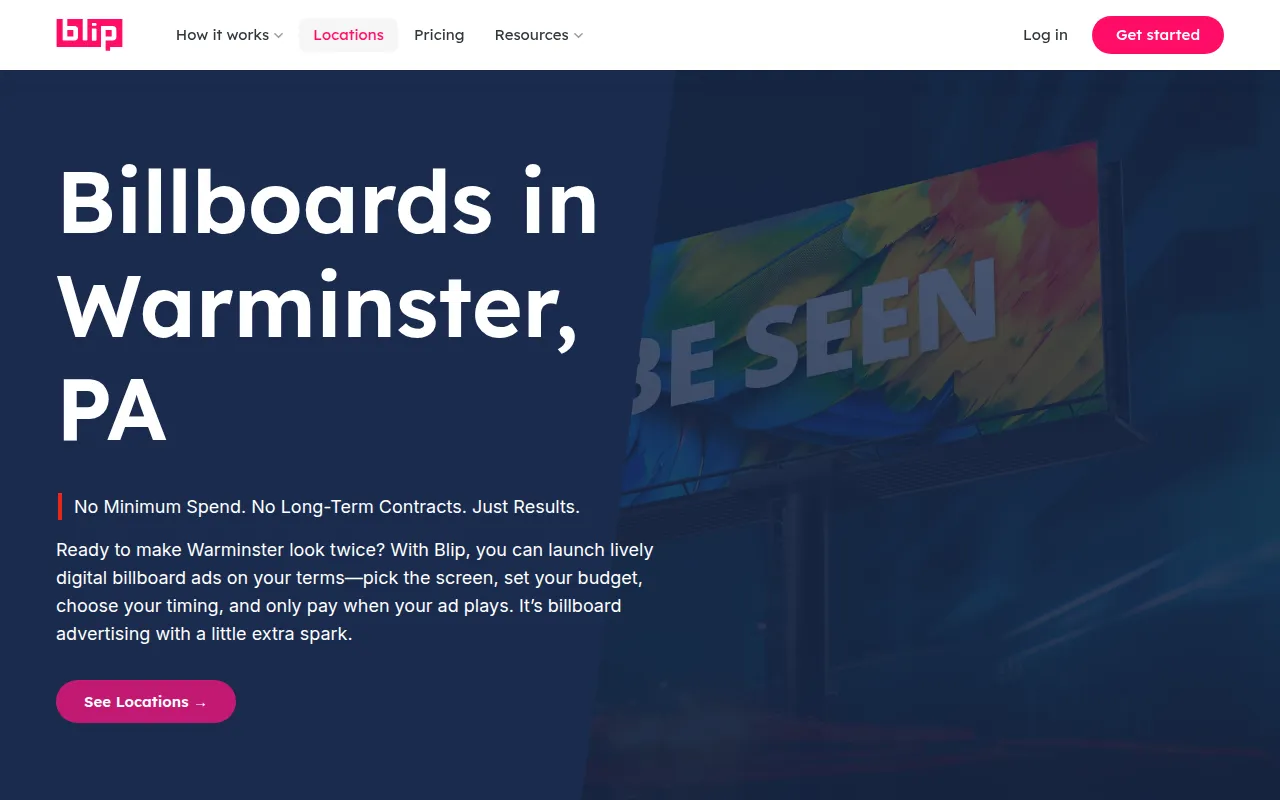
Blip is a self-serve marketplace for digital billboard ads. You pick boards on a map, set a daily budget and schedule, and upload your ad. Each "blip" is an 8-second display on a rotating digital billboard, priced from $0.01 per display depending on location, time of day and demand. There is no minimum spend and no contract, and daily budgets start at $5 to $20 depending on the location.
Blip's own location pages show what a budget buys: at $20 a day, a statewide Colorado buy shows about 303 displays a day, or about $0.07 per display, while a New York City buy shows far fewer, at about $0.38 per display. Skip Blip if you need guaranteed placement on one premium board: Blip sells plays in a rotation, not exclusive use of a face. It fits when you want to test billboards with a small budget, learn which boards and hours work, and scale only what performs.
6. Clear Channel Outdoor: best for direct buys on premium roadside and airport screens
Clear Channel Outdoor is one of the largest out-of-home media owners in the US. It sells digital faces directly: roadside bulletins along major highways, airport screens, transit and place-based inventory. A direct buy means a fixed monthly rate for a guaranteed share of a screen's loop, rather than an auction CPM, and the sales team quotes per market and per face.
Clear Channel Outdoor publishes no prices, because direct rates depend on the market, the face and the share of voice you buy. Skip Clear Channel Outdoor if you want self-serve programmatic buying: its route is a direct sale, and the minimums are higher than a Blip test. It fits when you want a premium location with guaranteed placement, such as a highway bulletin or an airport screen, and you have the budget for a four-week flight.
What $500 buys on digital OOH
CPM makes DOOH easy to compare once you do the arithmetic. At $10 CPM, $500 buys 50,000 impressions. At $4 CPM on a roadside bulletin, the same $500 buys 125,000 impressions. At $25 CPM in an airport, it buys 20,000 impressions. The impressions are not equal: an airport impression reaches a traveller with dwell time, while a roadside impression reaches a driver for a few seconds. Compare CPMs only inside the same venue type.
Blip changes the arithmetic for small budgets. A $20 daily budget in Colorado buys about 303 displays a day, so $500 buys roughly 7,500 displays over 25 days. That is far fewer impressions than $500 of programmatic CPM buying, but each display is a full 8 seconds on a board you chose, and there is no $1,500 test minimum. The right comparison is not impressions per dollar: it is whether you need guaranteed placement on a chosen board or cheap reach across many screens.
Digital OOH terms worth knowing
DOOH. Digital out-of-home: advertising on digital screens outside the home, from roadside billboards to gym screens.
Programmatic DOOH. Buying DOOH impressions through automated auctions, the same way programmatic display buys web impressions. The buyer sets targeting and a bid, and the platform serves the ad when the bid wins.
DSP. Demand-side platform: the tool advertisers use to buy impressions. Vistar Media and AdQuick are DSPs.
SSP. Supply-side platform: the tool media owners use to sell their inventory to DSPs. Place Exchange and Broadsign Reach are SSPs.
CPM. Cost per thousand impressions. The standard unit for programmatic DOOH pricing.
Share of voice. The percentage of a screen's loop your ad occupies. A direct buy usually sells a share of voice for a fixed monthly rate, such as 25% of the loop for four weeks.
Geopath. The US standard for measuring out-of-home audiences. Geopath ratings are the basis for most verified DOOH impression counts.
Mistakes to avoid with digital OOH advertising platforms
- Comparing CPMs across venue types. A $4 roadside CPM and a $25 airport CPM are different products. Compare roadside with roadside and airport with airport.
- Buying a DSP when you need a single board. Programmatic platforms are built for campaigns across many screens. A single premium board is a direct buy from the media owner.
- Buying an SSP thinking it is a DSP. Place Exchange sells inventory to DSPs. An advertiser who signs up expecting a buying tool will find nothing to buy with.
- Forgetting creative specs. DOOH creative is not a web banner. Check the screen's resolution, aspect ratio and loop length before you design, or your ad will be cropped or cut short.
- Running one board for one week. A single board for a few days rarely builds enough frequency to be remembered. Blip's low minimum is for testing; a real campaign needs repetition over weeks.
- Skipping measurement. Ask how impressions are counted before you buy. Geopath-standard data is the benchmark in the US, and a platform that cannot explain its counting is a platform to avoid.
What to check before you buy
Decide whether you need reach or placement: reach points to Vistar or AdQuick, placement points to Blip or a direct buy from Clear Channel Outdoor. Get the CPM in writing for your market and your venue type, and ask whether the quote is programmatic or direct, because the two are priced differently. For the wider paid-media decision, the best programmatic advertising platforms comparison covers the DSPs that also buy DOOH, and the best digital billboard advertising companies post covers the direct-buy side. If you run retail campaigns, best retail advertising platforms is the closer comparison, and the SEO vs Google Ads guide helps you weigh screen spend against search spend. If you want help planning paid media, Adziq's Google Ads service page explains how campaign planning is scoped.
Common questions
What is digital OOH advertising?
Digital out-of-home advertising, or DOOH, is advertising on digital screens outside the home: roadside digital billboards, airport screens, retail displays, gym screens and transit screens. Unlike static billboards, DOOH creative can be swapped, scheduled by time of day and bought by impressions.
How much does digital OOH advertising cost?
Most DOOH is priced by CPM, or cost per thousand impressions. Roadside digital bulletins typically run $4 to $12 CPM, place-based venues $8 to $25, and airports $25 to $45. Blip sells single 8-second displays from $0.01, and programmatic test campaigns usually start at $1,500 to $2,500.
What is the difference between a DSP and an SSP in DOOH?
A DSP, or demand-side platform, is the tool advertisers use to buy impressions, such as Vistar Media or AdQuick. An SSP, or supply-side platform, is the tool media owners use to sell their inventory, such as Place Exchange. The two connect in real time when an ad is served.
Can a small business afford digital billboards?
Yes, through Blip. You set a daily budget from $5 to $20 depending on the location, pay per 8-second display, and there is no minimum spend and no contract. A $20 daily budget buys roughly 36 to 303 displays a day depending on the market.
How do you measure digital OOH advertising?
DOOH is measured with verified impressions, usually based on Geopath-standard data in the US, plus footfall and mobile-location studies for campaigns that need proof of visits. Ask the platform how impressions are counted before you compare CPMs.
Sources
- Vistar Media homepage
- AdQuick homepage
- Place Exchange homepage
- Broadsign homepage
- Blip Billboards homepage
- Clear Channel Outdoor homepage
Adziq sells marketing services and does not accept payment for placement in its articles. See our editorial policy.